


 Cart
Cart
 sales@molnova.com



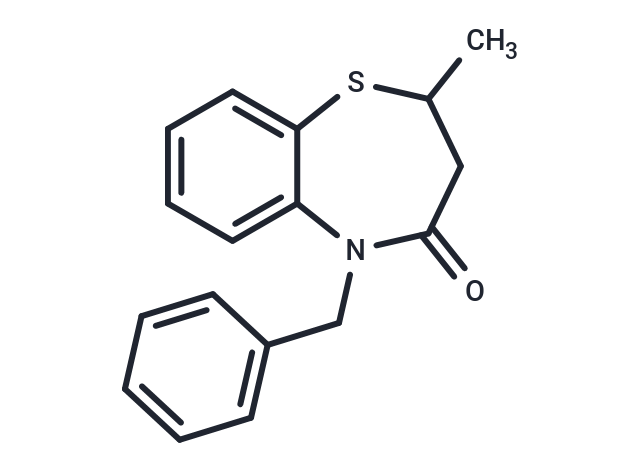
GSK-3β inhibitor 14
CAS No. 863004-48-2
GSK-3β inhibitor 14( —— )
Catalog No. M36031 CAS No. 863004-48-2
GSK-3β inhibitor 14 (1,5-Benzothiazepin-4(5H)-one, 2,3-dihydro-2-methyl-5-(phenylmethyl)-) is a weak GSK-3β inhibitor, IC50﹥ 100μM.
Purity : >98% (HPLC)
 COA
Datasheet
HNMR
HPLC
MSDS
Handing Instructions
COA
Datasheet
HNMR
HPLC
MSDS
Handing Instructions
| Size | Price / USD | Stock | Quantity |
| 5MG | 114 | In Stock |


|
| 10MG | 174 | In Stock |
|
| 25MG | 296 | In Stock |
|
| 50MG | 419 | In Stock |
|
| 100MG | 577 | In Stock |
|
| 200MG | 793 | In Stock |
|
| 500MG | Get Quote | In Stock |
|
| 1G | Get Quote | In Stock |
|
Biological Information
-
Product NameGSK-3β inhibitor 14
-
NoteResearch use only, not for human use.
-
Brief DescriptionGSK-3β inhibitor 14 (1,5-Benzothiazepin-4(5H)-one, 2,3-dihydro-2-methyl-5-(phenylmethyl)-) is a weak GSK-3β inhibitor, IC50﹥ 100μM.
-
DescriptionGSK-3β inhibitor 14 (Compound 6i), benzothiazepinone derivative, is a weak GSK-3β inhibitor (IC50 >100 μM).
-
In Vitro——
-
In Vivo——
-
Synonyms——
-
PathwayPI3K/Akt/mTOR signaling
-
TargetGSK-3
-
RecptorGSK-3
-
Research Area——
-
Indication——
Chemical Information
-
CAS Number863004-48-2
-
Formula Weight283.39
-
Molecular FormulaC17H17NOS
-
Purity>98% (HPLC)
-
Solubility——
-
SMILESC(N1C=2C(SC(C)CC1=O)=CC=CC2)C3=CC=CC=C3
-
Chemical Name——
Shipping & Storage Information
-
Storage(-20℃)
-
ShippingWith Ice Pack
-
Stability≥ 2 years
Reference
1. Zhang P, et al. Design, synthesis and biological evaluation of benzothiazepinones (BTZs) as novel non-ATP competitive inhibitors of glycogen synthase kinase-3β (GSK-3β). Eur J Med Chem. 2013 Mar;61:95-103.?
molnova catalog



related products
-
GSK3-IN-3
GSK3-IN-3 is a mitochondrial autophagy (mitophagy) inducer and GSK-3 inhibitor (IC50: 3.01 μM) that induces parkin-dependent mitochondrial autophagy.
-
TDZD-8
A potent, selective, non-ATP competitive GSK-3β inhibitor with IC50 of 2 uM; displays no activity against PKA, CK-2, PKC, and CDK1 (IC50>100 uM).
-
RHPS4
RHPS4 is a potent inhibitor of Telomerase at submicromolar.
