


 Cart
Cart
 sales@molnova.com



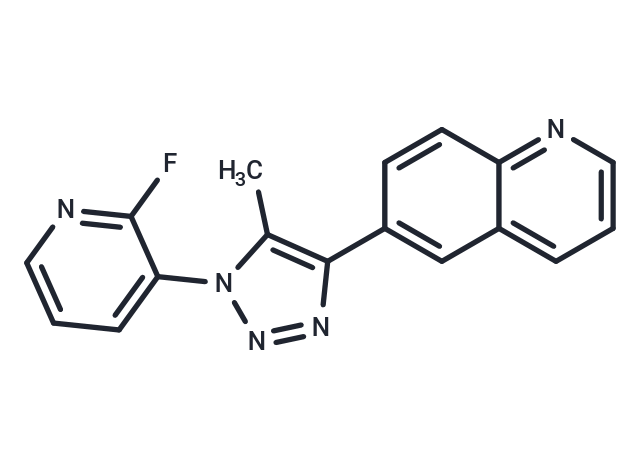
FPTQ B
CAS No. 864863-72-9
FPTQ B( —— )
Catalog No. M35294 CAS No. 864863-72-9
FPTQ is a highly effective antagonist of mGluR 1, displaying IC50 values of 6 nM and 1.4 nM for human and mouse mGluR1 respectively . In addition to its robust inhibitory properties, FPTQ exhibits notable antioxidant and anti-inflammatory effects in both in vitro and in vivo settings .
Purity : >98% (HPLC)
 COA
Datasheet
HNMR
HPLC
MSDS
Handing Instructions
COA
Datasheet
HNMR
HPLC
MSDS
Handing Instructions
| Size | Price / USD | Stock | Quantity |
| 1 mL x 10 mM in DMSO | 112 | In Stock |


|
| 2MG | 64 | In Stock |
|
| 5MG | 107 | In Stock |
|
| 10MG | 155 | In Stock |
|
| 25MG | 311 | In Stock |
|
| 50MG | 411 | In Stock |
|
| 100MG | 545 | In Stock |
|
| 200MG | Get Quote | In Stock |
|
| 500MG | Get Quote | In Stock |
|
| 1G | Get Quote | In Stock |
|
Biological Information
-
Product NameFPTQ B
-
NoteResearch use only, not for human use.
-
Brief DescriptionFPTQ is a highly effective antagonist of mGluR 1, displaying IC50 values of 6 nM and 1.4 nM for human and mouse mGluR1 respectively . In addition to its robust inhibitory properties, FPTQ exhibits notable antioxidant and anti-inflammatory effects in both in vitro and in vivo settings .
-
DescriptionFPTQ is potent mGluR1 antagonist with IC50 values of 6 nM and 1.4 nM for human and mouse mGluR1 respectively. FPTQ has anti-oxidant and anti-inflammatory effects in vitro and in vivo.
-
In VitroFPTQ (0.5-10 μM) does not shows any cytotoxicity was not observed at 0.5, 1, 5, and 10 μM in RAW264.7 macrophage cells.FPTQ (1-20 μM; 24 hours) reduces LPS-induced NO production at > 1 μM FPTQ, and at 10 μM, FPTQ treatment causes a 31% anti-oxidant effect in RAW264.7 macrophage cells.FPTQ (1-20 μM; 24 hours) dramaticly decreases LPS-induced expression levels of IL-1β and Il-6. At a concentration of 10 μM, FPTQ causes a 27% and 44% reduction in the mRNA expression of IL-1β and Il-6, respectively in RAW264.7 macrophage cells.RT-PCR Cell Line:RAW264.7 macrophage cells Concentration:1, 10, or 20 μM Incubation Time:24 hours Result:Decreased IL-1β and IL-6 mRNA expression
-
In VivoFPTQ (5-20 μM) decreases the number of neutrophils migrating to the amputation site in zebrafish larvae by tail amputation. In the tailfin wound method, the number of neutrophils collecting at the wound site also decreases in a dose-dependent manner in zebrafish.In a LPS-induced inflammation zebrafish model, LPS solution is injected into the yolks of Tg(mpx:EGFP)i114 zebrafish larvae and exposed the zebrafish larvae immediately to FPTQ treatment.FPTQ (20 μM; 4 hours) significantly decreases the fluorescent neutrophils after yolk injection and has an anti-inflammatory effect during the early phase of inflammation.
-
Synonyms——
-
PathwayNeuroscience
-
TargetGluR
-
RecptorGluR
-
Research Area——
-
Indication——
Chemical Information
-
CAS Number864863-72-9
-
Formula Weight305.31
-
Molecular FormulaC17H12FN5
-
Purity>98% (HPLC)
-
SolubilityIn Vitro:?DMSO : 33.33 mg/mL (109.17 mM; Ultrasonic )
-
SMILESCc1c(nnn1-c1cccnc1F)-c1ccc2ncccc2c1
-
Chemical Name——
Shipping & Storage Information
-
Storage(-20℃)
-
ShippingWith Ice Pack
-
Stability≥ 2 years
Reference
1. Fujinaga M et al. Synthesis and evaluation of 6-[1-(2-[(18)F]fluoro-3-pyridyl)-5-methyl-1H-1,2,3-triazol-4-yl]quinoline for positron emission tomography imaging of the metabotropic glutamate receptor type 1 in brain. Bioorg Med Chem, 2011 Jan 1, 19(1):102?
molnova catalog



related products
-
S 18986
S 18986 is a selective, orally active, brain-penetrant positive allosteric modulator of AMPA-type receptors that enhances cognition in rodents by inducing the release of noradrenaline and acetylcholine in the rat hippocampus, subsequently improving object-recognition memory.
-
CX717
CX 717 is a positive allosteric modulator of the AMPA receptor with antidepressant-like effects and potential use in adult attention deficit hyperactivity disorder (ADHD) research .
-
MNI 137
MNI 137 is a negative allosteric modulator of mGlu2. MNI 137 inhibits glutamate-induced calcium mobilization with IC50s of 8.3 and 12.6 nM for human and rat.
