


 Cart
Cart
 sales@molnova.com



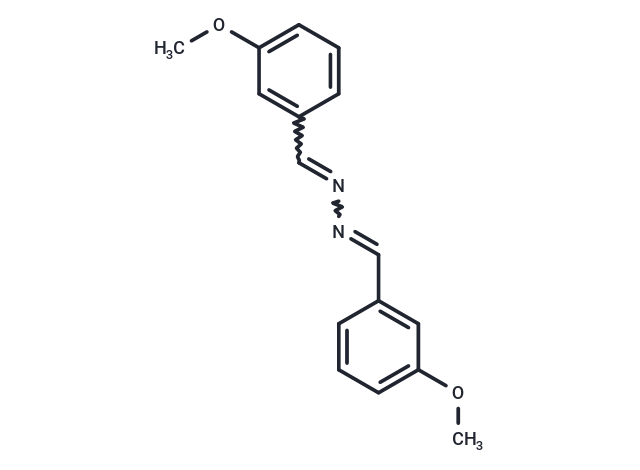
DMeOB
CAS No. 40252-74-2
DMeOB( —— )
Catalog No. M33845 CAS No. 40252-74-2
DMeOB (3,3'-Dimethoxybenzaldazine) is a negative regulator with mGluR5 agonist activity and can be used to study neurological diseases.
Purity : >98% (HPLC)
 COA
Datasheet
HNMR
HPLC
MSDS
Handing Instructions
COA
Datasheet
HNMR
HPLC
MSDS
Handing Instructions
| Size | Price / USD | Stock | Quantity |
| 1 mL x 10 mM in DMSO | 48 | In Stock |


|
| 2MG | 29 | In Stock |
|
| 5MG | 46 | In Stock |
|
| 10MG | 73 | In Stock |
|
| 25MG | 148 | In Stock |
|
| 50MG | 230 | In Stock |
|
| 100MG | 368 | In Stock |
|
| 200MG | 538 | In Stock |
|
| 500MG | Get Quote | In Stock |
|
| 1G | Get Quote | In Stock |
|
Biological Information
-
Product NameDMeOB
-
NoteResearch use only, not for human use.
-
Brief DescriptionDMeOB (3,3'-Dimethoxybenzaldazine) is a negative regulator with mGluR5 agonist activity and can be used to study neurological diseases.
-
DescriptionDMeOB is an agonist ofmGluR5 receptor with an IC50 of 3 μM. DMeOB has a negative modulatory effect.
-
In Vitro——
-
In Vivo——
-
Synonyms——
-
PathwayNeuroscience
-
TargetGluR
-
RecptorGluR
-
Research Area——
-
Indication——
Chemical Information
-
CAS Number40252-74-2
-
Formula Weight268.31
-
Molecular FormulaC16H16N2O2
-
Purity>98% (HPLC)
-
Solubility——
-
SMILESN(N=CC=1C=CC=C(OC)C1)=CC=2C=CC=C(OC)C2
-
Chemical Name——
Shipping & Storage Information
-
Storage(-20℃)
-
ShippingWith Ice Pack
-
Stability≥ 2 years
Reference
1. O'Brien JA, et al. A family of highly selective allosteric modulators of the metabotropic glutamate receptor subtype 5. Mol Pharmacol. 2003 Sep;64(3):731-40.?
molnova catalog



related products
-
S 18986
S 18986 is a selective, orally active, brain-penetrant positive allosteric modulator of AMPA-type receptors that enhances cognition in rodents by inducing the release of noradrenaline and acetylcholine in the rat hippocampus, subsequently improving object-recognition memory.
-
ML289
ML289 (VU0463597) is a potent, selective, and CNS-penetrant negative allosteric modulator of mGlu3 (IC50=0.66 μM), with over 15-fold selectivity compared to mGlu2 and no activity against mGlu5.
-
Memantine hydrochlor...
Memantine is an uncompetitive NMDA receptor antagonist. When using HEK293 cells express recombinant rat NMDA receptors, memantine shows inhibition of L-glutamate-mediated response with a dose- and voltage-dependent manner.
