


 Cart
 sales@molnova.com




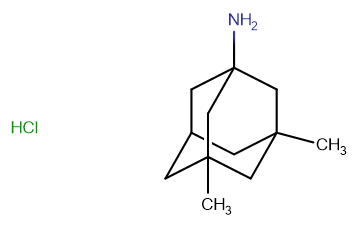
Memantine hydrochloride
CAS No. 41100-52-1
Memantine hydrochloride( Akatinol | Axura | Ebix | Namenda | NSC 102290 | SUN Y7017 )
Catalog No. M14411 CAS No. 41100-52-1
Memantine is an uncompetitive NMDA receptor antagonist. When using HEK293 cells express recombinant rat NMDA receptors, memantine shows inhibition of L-glutamate-mediated response with a dose- and voltage-dependent manner.
Purity : >98% (HPLC)
 COA
Datasheet
HNMR
HPLC
MSDS
Handing Instructions
| Size | Price / USD | Stock | Quantity |
| 100MG | Get Quote | In Stock |


|
| 200MG | 39 | In Stock |
|
| 500MG | 47 | In Stock |
|
| 1G | 59 | In Stock |
|
Biological Information
-
Product NameMemantine hydrochloride
-
NoteResearch use only, not for human use.
-
Brief DescriptionMemantine is an uncompetitive NMDA receptor antagonist. When using HEK293 cells express recombinant rat NMDA receptors, memantine shows inhibition of L-glutamate-mediated response with a dose- and voltage-dependent manner.
-
DescriptionMemantine is an uncompetitive NMDA receptor antagonist. When using HEK293 cells express recombinant rat NMDA receptors, memantine shows inhibition of L-glutamate-mediated response with a dose- and voltage-dependent manner. Memantine also has a rapid unblocking kinetics. Memantine is used clinically in spasticity, Parkinson's disease and Alzheimer's disease. Memantine is found to attenuate the deleterious action of Aβ in the in vitro numerous studies. It is probably due to the decreased tau phosphorylation caused by memantine.(In Vitro):Memantine (hydrochloride) (D-145 (hydrochloride)) is a moderate-affinity, uncompetitive, voltage-dependent, NMDA-receptor antagonist with fast on/off kinetics that inhibits excessive calcium influx induced by chronic overstimulation of the NMDA receptor. Memantine is approved in the US and the EU for the treatment of patients with moderate to severe dementia of the Alzheimer's type. Memantine has considerable therapeutic potential for the myriad of clinical entities associated with NMDA receptor-mediated neurotoxicity. Memantine blocked 200 microM NMDA-evoked responses with a 50% inhibition constant (IC50) of approximately 1 microM at -60 mV and an empirical Hill coefficient of approximately.
-
In VitroMemantine (hydrochloride) (D-145 (hydrochloride)) is a moderate-affinity, uncompetitive, voltage-dependent, NMDA-receptor antagonist with fast on/off kinetics that inhibits excessive calcium influx induced by chronic overstimulation of the NMDA receptor. Memantine is approved in the US and the EU for the treatment of patients with moderate to severe dementia of the Alzheimer's type. Memantine has considerable therapeutic potential for the myriad of clinical entities associated with NMDA receptor-mediated neurotoxicity. Memantine blocked 200 microM NMDA-evoked responses with a 50% inhibition constant (IC50) of approximately microM at -60 mV and an empirical Hill coefficient of approximately .
-
In Vivo——
-
SynonymsAkatinol | Axura | Ebix | Namenda | NSC 102290 | SUN Y7017
-
PathwayNeuroscience
-
TargetGluR
-
RecptorAMPA| NMDA receptor| Kainate receptor
-
Research AreaNeurological Disease
-
Indication——
Chemical Information
-
CAS Number41100-52-1
-
Formula Weight215.76
-
Molecular FormulaC12H22ClN
-
Purity>98% (HPLC)
-
SolubilityEthanol: 43 mg/mL (199.29 mM); Water: 30 mg/mL (139.04 mM); DMSO: 43 mg/mL (199.29 mM)
-
SMILESCl.CC12CC3CC(C)(C1)CC(N)(C3)C2
-
Chemical Name——
Shipping & Storage Information
-
Storage(-20℃)
-
ShippingWith Ice Pack
-
Stability≥ 2 years
Reference
1.Bresink I, et al. British journal of pharmacology, 1996, 119(2): 195-204.
molnova catalog


related products
-
HBT1
HBT1 is an AMPA receptor potentiator that induces production of brain-derived neurotrophic factor (BDNF) and exhibits little agonistic effect in primary neurons. HBT1 binds to ligand-binding domain of AMPA-R in glutamate dependent manner.HBT1 bound to the ligand-binding domain (LBD) of AMPA-R in a glutamate-dependent manner.?
-
Cutamesine dihydroch...
Cutamesine dihydrochloride is a selective?σ1 receptor agonist (IC50: 17.4 nM).
-
FPTQ B
FPTQ is a highly effective antagonist of mGluR 1, displaying IC50 values of 6 nM and 1.4 nM for human and mouse mGluR1 respectively . In addition to its robust inhibitory properties, FPTQ exhibits notable antioxidant and anti-inflammatory effects in both in vitro and in vivo settings .
