


 Cart
Cart
 sales@molnova.com



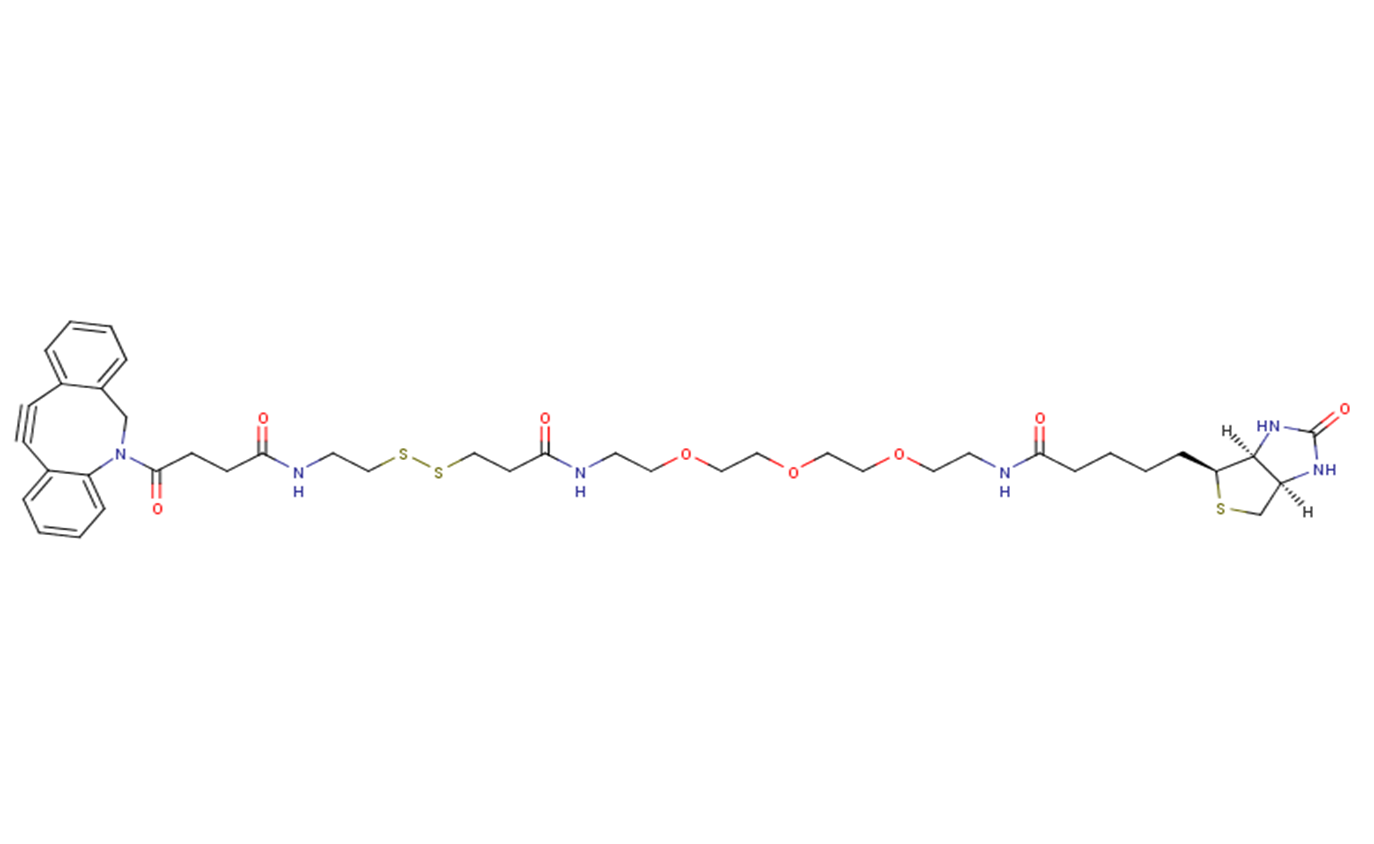
DBCO-S-S-PEG3-biotin
CAS No. 1430408-09-5
DBCO-S-S-PEG3-biotin( —— )
Catalog No. M22836 CAS No. 1430408-09-5
DBCO-S-S-PEG3-biotin is a cleavable reagent for introduction of a biotin moiety to azide-containing biomolecules using copper-free Click Chemistry. The disulfide bond in this linker can be cleaved using reducing agents such as DTT, BME and TCEP to remove the biotin label. PEG Linkers can be used in the synthesis of PROTACs.
Purity : >98% (HPLC)
 COA
Datasheet
HNMR
HPLC
MSDS
Handing Instructions
COA
Datasheet
HNMR
HPLC
MSDS
Handing Instructions
| Size | Price / USD | Stock | Quantity |
| 5MG | 73 | In Stock |


|
| 10MG | 122 | In Stock |
|
| 25MG | 226 | In Stock |
|
| 100MG | Get Quote | In Stock |
|
| 200MG | Get Quote | In Stock |
|
| 500MG | Get Quote | In Stock |
|
| 1G | Get Quote | In Stock |
|
Biological Information
-
Product NameDBCO-S-S-PEG3-biotin
-
NoteResearch use only, not for human use.
-
Brief DescriptionDBCO-S-S-PEG3-biotin is a cleavable reagent for introduction of a biotin moiety to azide-containing biomolecules using copper-free Click Chemistry. The disulfide bond in this linker can be cleaved using reducing agents such as DTT, BME and TCEP to remove the biotin label. PEG Linkers can be used in the synthesis of PROTACs.
-
DescriptionDBCO-S-S-PEG3-biotin is a cleavable reagent for introduction of a biotin moiety to azide-containing biomolecules using copper-free Click Chemistry. The disulfide bond in this linker can be cleaved using reducing agents such as DTT, BME and TCEP to remove the biotin label. PEG Linkers can be used in the synthesis of PROTACs.PROTACs contain two different ligands connected by a linker; one is a ligand for an E3 ubiquitin ligase and the other is for the target protein. PROTACs exploit the intracellular ubiquitin-proteasome system to selectively degrade target proteins.
-
In VitroPROTACs contain two different ligands connected by a linker; one is a ligand for an E3 ubiquitin ligase and the other is for the target protein. PROTACs exploit the intracellular ubiquitin-proteasome system to selectively degrade target proteins.
-
In Vivo——
-
Synonyms——
-
PathwayPROTACs
-
TargetPROTAC
-
RecptorPEGs
-
Research Area——
-
Indication——
Chemical Information
-
CAS Number1430408-09-5
-
Formula Weight869.12
-
Molecular FormulaC42H56N6O8S3
-
Purity>98% (HPLC)
-
SolubilityNA
-
SMILESO=C(N1C2=CC=CC=C2C#CC3=CC=CC=C3C1)CCC(NCCSSCCC(NCCOCCOCCOCCNC(CCCC[C@H]4[C@](NC5=O)([H])[C@](N5)([H])CS4)=O)=O)=O
-
Chemical Name——
Shipping & Storage Information
-
Storage(-20℃)
-
ShippingWith Ice Pack
-
Stability≥ 2 years
Reference
1. An S, et al. Small-molecule PROTACs: An emerging and promising approach for the development of targeted therapy drugs. EBioMedicine. 2018 Oct;36:553-562
molnova catalog



related products
-
Amino-PEG11-amine
Amino-PEG11-amine, a PEG-based (12 units) PROTAC linker used to combine two mono diethylstilbestrol (DES)-based ligands, provides an alternative strategy for preparing more selective and active ER antagonists for endocrine therapy of breast cancer.
-
BETd-260 trifluoroac...
BETd-260 trifluoroacetate (ZBC260, BETd 260 TFA) is a novel PROTAC BET degrader that tether HJB97 to a ligand for the E3 ubiquitin ligase VHL.
-
HDAC6 degrader 9c
HDAC6 degrader 9c (dHDAC6 9c) is a bifunctional molecule (dHDAC6) that could selectively degrade HDAC6, by conjugating non-selective HDAC inhibitor to a thalidomide-type E3 ligase ligand.
