


 Cart
Cart
 sales@molnova.com



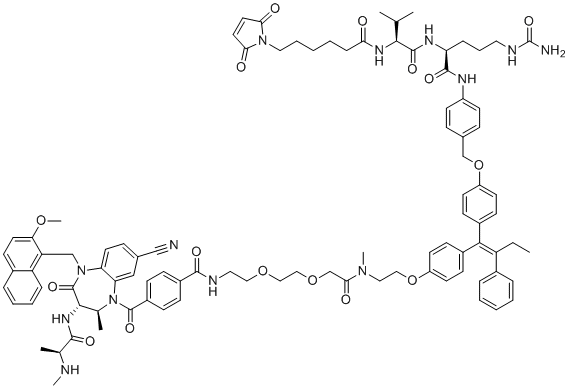
PAC
CAS No. 2158322-33-7
PAC( Compound PAC1 )
Catalog No. M13446 CAS No. 2158322-33-7
PAC1 (Compound PAC1) is a novel PROTAC antibody conjugate, more potent estrogen receptor-alpha (ERα) degrader compared to PROTAC without antibody conjugation.
Purity : >98% (HPLC)
 COA
Datasheet
HNMR
HPLC
MSDS
Handing Instructions
COA
Datasheet
HNMR
HPLC
MSDS
Handing Instructions
| Size | Price / USD | Stock | Quantity |
| 100MG | Get Quote | Get Quote |


|
| 200MG | Get Quote | Get Quote |
|
| 500MG | Get Quote | Get Quote |
|
| 1G | Get Quote | Get Quote |
|
Biological Information
-
Product NamePAC
-
NoteResearch use only, not for human use.
-
Brief DescriptionPAC1 (Compound PAC1) is a novel PROTAC antibody conjugate, more potent estrogen receptor-alpha (ERα) degrader compared to PROTAC without antibody conjugation.
-
DescriptionPAC1 (Compound PAC1) is a novel PROTAC antibody conjugate, more potent estrogen receptor-alpha (ERα) degrader compared to PROTAC without antibody conjugation.
-
In VitroTreatment of HER2 expressing cells with HER2 antibody containing PAC Anti-HER2(Endox-XIAP) results in a marked decreased Estrogen Receptor-alpha (ERα) levels with an IC50 of 132 ng/mL. The PROTAC-Antibody Conjugate (PAC) molecules comprise an antibody conjugated via a linker (L1) to a PROTAC, wherein the PROTAC comprises an ubiquitin E3 ligase binding group (“E3LB”), a linker (“L2”) and a protein binding group (“PB”). The following sections describe the components that comprise the PAC. To obtain a PAC having potent efficacy and a desirable therapeutic index, the following components are provided. 1. Antibody (Ab): The antibody portion of a PAC can target a cell that expresses an antigen whereby the antigen specific PAC is delivered intracellularly to the target cell, typically through endocytosis While PACs that comprise an antibody directed to an antigen that is not found on the cell surface may result in less specific intracellular delivery of the PROTAC portion into the cell, the PAC may still undergo pinocytosis. 2. Linkers (L1): A“linker” (L1) is a bifunctional or multifunctional moiety that can be used to link one or more PROTAC moieties (D) to an antibody (Ab) to form a PAC. In some embodiments, PACs can be prepared using a L1 having reactive functionalities for covalently attaching to the PROTAC and to the antibody. 3. PROTAC(D) .
-
In Vivo——
-
SynonymsCompound PAC1
-
PathwayPROTACs
-
TargetPROTAC
-
RecptorPROTAC
-
Research Area——
-
Indication——
Chemical Information
-
CAS Number2158322-33-7
-
Formula Weight1674.93
-
Molecular FormulaC94H107N13O16
-
Purity>98% (HPLC)
-
SolubilityIn Vitro:?DMSO : 70 mg/mL (41.79 mM)
-
SMILESCCC(=C(C1=CC=C(C=C1)OCCN(C)C(=O)COCCOCCNC(=O)C2=CC=C(C=C2)C(=O)N3C(C(C(=O)N(C4=C3C=C(C=C4)C#N)CC5=C(C=CC6=CC=CC=C65)OC)NC(=O)C(C)NC)C)C7=CC=C(C=C7)OCC8=CC=C(C=C8)NC(=O)C(CCCNC(=O)N)NC(=O)C(C(C)C)NC(=O)CCCCCN9C(=O)C=CC9=O)C1=CC=CC=C1
-
Chemical Name4-((2S,3S)-8-Cyano-5-((2-methoxynaphthalen-1-yl)methyl)-2-methyl-3-((S)-2-(methylamino)propanamido)-4-oxo-2,3,4,5-tetrahydro-1H-benzo[b][1,4]diazepine-1-carbonyl)-N-(2-(2-(2-((2-(4-((Z)-1-(4-((4-((S)-2-((S)-2-(6-(2,5-dioxo-2,5-dihydro-1H-pyrrol-1-yl)hexan
Shipping & Storage Information
-
Storage(-20℃)
-
ShippingWith Ice Pack
-
Stability≥ 2 years
Reference
1. Thomas Pillow, et al. Protac antibody conjugates and methods of use. WO2017201449A1.
molnova catalog



related products
-
Sirt2-PROTAC-1
A novel SirReal-based PROTAC that induces isotype-selective Sirt2 degradation (IC50=0.25 uM).
-
dBET57
dBET57 is a novel BRD4 heterobifunctional small-molecule ligand (PROTAC), exhibits significant and selective degradation of BRD4 BD1 (DC50/5h=500 nM).
-
Mal-amido-PEG4-NHS e...
Mal-amido-PEG4-NHS ester is a PEG-based PROTAC linker that can be used in the synthesis of PROTACs. PROTACs contain two different ligands connected by a linker; one is a ligand for an E3 ubiquitin ligase and the other is for the target protein.
