


 Cart
Cart
 sales@molnova.com



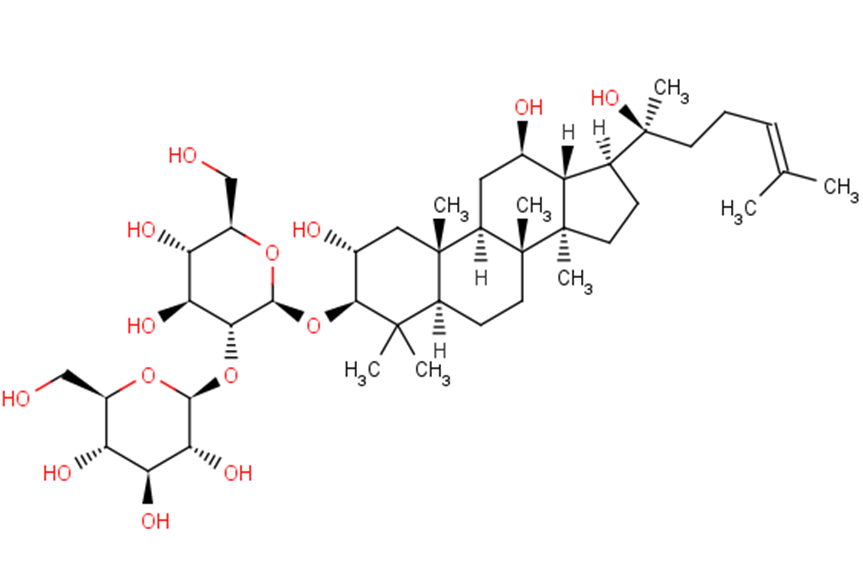
Gypenoside L
CAS No. 94987-09-4
Gypenoside L( —— )
Catalog No. M22119 CAS No. 94987-09-4
Gypenoside L inhibits autophagic flux and induces cell death in human esophageal cancer cells through endoplasm reticulum stress-mediated Ca2+ release.
Purity : >98% (HPLC)
 COA
Datasheet
HNMR
HPLC
MSDS
Handing Instructions
COA
Datasheet
HNMR
HPLC
MSDS
Handing Instructions
| Size | Price / USD | Stock | Quantity |
| 5MG | 258 | In Stock |


|
| 10MG | 377 | In Stock |
|
| 100MG | Get Quote | In Stock |
|
| 200MG | Get Quote | In Stock |
|
| 500MG | Get Quote | In Stock |
|
| 1G | Get Quote | In Stock |
|
Biological Information
-
Product NameGypenoside L
-
NoteResearch use only, not for human use.
-
Brief DescriptionGypenoside L inhibits autophagic flux and induces cell death in human esophageal cancer cells through endoplasm reticulum stress-mediated Ca2+ release.
-
DescriptionGypenoside L inhibits autophagic flux and induces cell death in human esophageal cancer cells through endoplasm reticulum stress-mediated Ca2+ release. It also inhibit non-small cell lung carcinoma A549 cell inhibitory activity.gypenoside L (Gyp-L), a saponin isolated from Gynostemma pentaphyllum, on cancer cell growth. We found that Gyp-L increased the SA-β-galactosidase activity, promoted the production of senescence-associated secretory cytokines, and inhibited cell proliferation of human liver and esophageal cancer cells. Moreover, Gyp-L caused cell cycle arrest at S phase, and activated senescence-related cell cycle inhibitor proteins (p21 and p27) and their upstream regulators. In addition, Gyp-L activated p38 and ERK MAPK pathways and NF-κB pathway to induce senescence. Consistently, adding chemical inhibitors efficiently counteracted the Gyp-L-mediated senescence, growth inhibition, and cell cycle arrest in cancer cells. Furthermore, treatment with Gyp-L, enhanced the cytotoxicity of clinic therapeutic drugs, including 5-fluorouracil and cisplatin, on cancer cells. Overall, these results indicate that Gyp-L inhibits proliferation of cancer cells by inducing senescence and renders cancer cells more sensitive to chemotherapy.
-
In VitroGypenoside L (20-80 μg/mL; 24 h) increases the mRNA expression levels of SASP, such as IL-1α, IL-6, TIMP-1, CXCL-1 and CXCL-2 in HepG2 and ECA-109 cells.Gypenoside L (20-80 μg/mL; 24 h) causes cell cycle arrest at S phase.GPL (3.125-100 μg/mL) significantly inhibits LPS-induced NO accumulation in RAW264.7 cells.
-
In Vivo——
-
Synonyms——
-
PathwayImmunology/Inflammation
-
TargetROS
-
RecptorROS|Calcium Channel
-
Research Area——
-
Indication——
Chemical Information
-
CAS Number94987-09-4
-
Formula Weight801
-
Molecular FormulaC42H72O14
-
Purity>98% (HPLC)
-
SolubilityIn Vitro:?DMSO : 100 mg/mL (124.84 mM)
-
SMILESC/C(C)=C\CC[C@](C)(O)[C@H]6CC[C@]5(C)[C@@H]6[C@H](O)C[C@H]4[C@@]5(C)CC[C@H]3C(C)(C)[C@@H](O[C@@H]2O[C@H](CO)[C@@H](O)[C@H](O)[C@H]2O[C@@H]1O[C@H](CO)[C@@H](O)[C@H](O)[C@H]1O)[C@H](O)C[C@@]34C
-
Chemical Name——
Shipping & Storage Information
-
Storage(-20℃)
-
ShippingWith Ice Pack
-
Stability≥ 2 years
Reference
1. Jingxin Ma , Xiaopeng Hu , Chenghui Liao,et al. Gypenoside L Inhibits Proliferation of Liver and Esophageal Cancer Cells by Inducing Senescence.[J]. Molecules (Basel, Switzerland), 2019.
molnova catalog



related products
-
Blumeatin
Blumeatin has antioxidant properties, free radical scavenging activity,and has xanthine oxidase (XO) inhibitory activity.
-
Sulcotrione
Sulcotrione is a β-triketone herbicide. It also can inhibit hydroxyphenylpyruvate dioxygenase.
-
2,8-Quinolinediol
2,8-Quinolinediol
