


 Cart
Cart
 sales@molnova.com



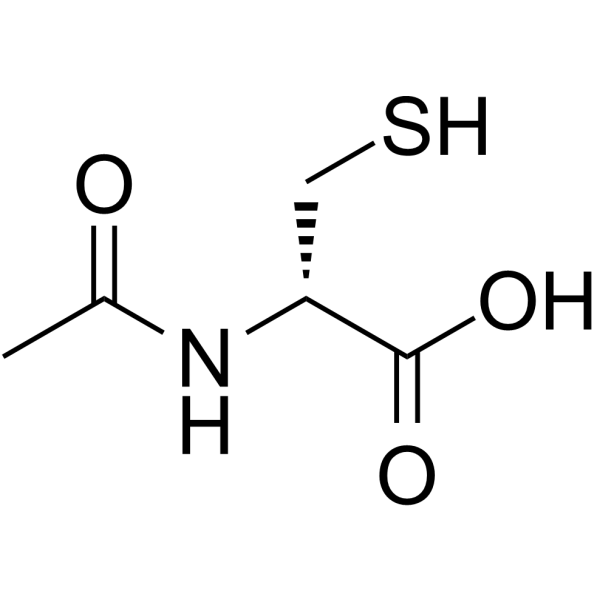
N-Acetyl-D-cysteine
CAS No. 26117-28-2
N-Acetyl-D-cysteine( (S)-2-Acetamido-3-mercaptopropanoic acid )
Catalog No. M28158 CAS No. 26117-28-2
N-Acetyl-D-cysteine has antioxidant activities and scavenges ROS through the reaction with its thiol group.
Purity : >98% (HPLC)
 COA
Datasheet
HNMR
HPLC
MSDS
Handing Instructions
COA
Datasheet
HNMR
HPLC
MSDS
Handing Instructions
| Size | Price / USD | Stock | Quantity |
| 10MG | 35 | In Stock |


|
| 25MG | 56 | In Stock |
|
| 50MG | 67 | In Stock |
|
| 100MG | 113 | In Stock |
|
| 200MG | 166 | In Stock |
|
| 500MG | 276 | In Stock |
|
| 1G | Get Quote | In Stock |
|
Biological Information
-
Product NameN-Acetyl-D-cysteine
-
NoteResearch use only, not for human use.
-
Brief DescriptionN-Acetyl-D-cysteine has antioxidant activities and scavenges ROS through the reaction with its thiol group.
-
DescriptionN-Acetyl-D-cysteine has antioxidant activities and scavenges ROS through the reaction with its thiol group.(In Vitro):Consistent with the known stereoselectivity of many biological processes, the unnatural D isomer of N-acetylcysteine failed to increase hepatic glutathione. Liver concentrations remained similar to control suggesting that the D isomer was unable to increase the rate of glutathione synthesis. The D isomer further differed from its L enantiomer in failing to increase the plasma concentration and the urinary excretion of inorganic sulfate. Congruent with these observations, much more N-acetyl-D-cysteine (47% of dose) was recovered unchanged in 24 hr urine than N-acetyl-L-cysteine (6.1% of dose).
-
In VitroN-Acetyl-D-cysteine (20 mM; 1 hour pretreatment; 12 hours) does not increase intracellular GSH levels, but GSH monoester does. D-NAC can not enhance hypoxic apoptosis. This demonstrate that GSH rather thanD-NAC or NAC is responsible for enhancing hypoxic apoptosis.
-
In Vivo——
-
Synonyms(S)-2-Acetamido-3-mercaptopropanoic acid
-
PathwayImmunology/Inflammation
-
TargetROS
-
RecptorTopo I|Topo II|Apoptosis
-
Research Area——
-
Indication——
Chemical Information
-
CAS Number26117-28-2
-
Formula Weight163.19
-
Molecular FormulaC5H9NO3S
-
Purity>98% (HPLC)
-
SolubilityIn Vitro:?H2O : 250 mg/mL (1531.96 mM)
-
SMILESCC(=O)N[C@H](CS)C(O)=O
-
Chemical Name——
Shipping & Storage Information
-
Storage(-20℃)
-
ShippingWith Ice Pack
-
Stability≥ 2 years
Reference
1.Chen DS, et al. Combinatorial synthesis of pyrazoloquinoline and pyrazoloacridine derivatives with high regioselectivity. Comb Chem High Throughput Screen. 2013 Jun 28;16(7):550-61.
molnova catalog



related products
-
Baicalein
The flavonoid component of Nepalese and Sino-Japanese crude drugs.1,2 Baicalein,a major flavone of Scutellariae baicalensis,inhibits the 12-lipoxygenase (12-LOX) pathway of arachidonic acid metabolism,which inhibits Y cell proliferation and induce.
-
Carminic acid
Carminic acid, the well-known red dyestuff from cochineal insects (Dactylopius spp.), is a potent feeding deterrent to ants.
-
CL097
CL097 is an effective agonist of TLR7 and TLR8. CL097 induces pro-inflammatory cytokines in macrophages and NADPH oxidase priming, thereby increasing the fMLF-stimulated ROS production.
