


 Cart
Cart
 sales@molnova.com



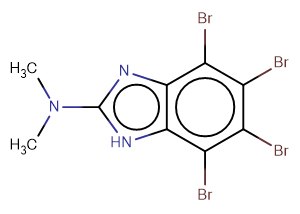
DMAT
CAS No. 749234-11-5
DMAT( CK2 Inhibitor | Casein kinase II Inhibitor )
Catalog No. M21590 CAS No. 749234-11-5
DMAT is a potent and specific inhibitor of CK2(IC50 value of 130 nM).
Purity : >98% (HPLC)
 COA
Datasheet
HNMR
HPLC
MSDS
Handing Instructions
COA
Datasheet
HNMR
HPLC
MSDS
Handing Instructions
| Size | Price / USD | Stock | Quantity |
| 1 mL x 10 mM in DMSO | 86 | In Stock |


|
| 5MG | 53 | In Stock |
|
| 10MG | 77 | In Stock |
|
| 25MG | 147 | In Stock |
|
| 50MG | 261 | In Stock |
|
| 100MG | 339 | In Stock |
|
| 200MG | Get Quote | In Stock |
|
| 500MG | Get Quote | In Stock |
|
| 1G | Get Quote | In Stock |
|
Biological Information
-
Product NameDMAT
-
NoteResearch use only, not for human use.
-
Brief DescriptionDMAT is a potent and specific inhibitor of CK2(IC50 value of 130 nM).
-
DescriptionDMAT is a potent and specific inhibitor of CK2(IC50 value of 130 nM).
-
In Vitro——
-
In Vivo——
-
SynonymsCK2 Inhibitor | Casein kinase II Inhibitor
-
PathwayMetabolic Enzyme/Protease
-
TargetCasein Kinase
-
RecptorCK2
-
Research Area——
-
Indication——
Chemical Information
-
CAS Number749234-11-5
-
Formula Weight476.79
-
Molecular FormulaC9H7Br4N3
-
Purity>98% (HPLC)
-
SolubilityDMSO:50 mg/mL (104.87 mM; Need ultrasonic)
-
SMILESCN(C)c1nc2c(Br)c(Br)c(Br)c(Br)c2[nH]1
-
Chemical Name——
Shipping & Storage Information
-
Storage(-20℃)
-
ShippingWith Ice Pack
-
Stability≥ 2 years
Reference
1.Lawnicka H Kowalewicz-Kulbat M Sicinska P et al. Anti-neoplastic effect of protein kinase CK2 inhibitor 2-dimethylamino-4567-tetrabromobenzimidazole (DMAT) on growth and hormonal activity of human adrenocortical carcinoma cell line (H295R) in vitro[J]. Cell & Tissue Research 2010 340(2):371-379.
molnova catalog



related products
-
CK2-IN-1
CK2-IN-1 is a potent, competitive inhibitor of ATP binding to Casein kinase 2(CK2) with IC50 of 9 nM.
-
Longdaysin
Longdaysin is an inhibitor of CK1α and CK1δ (IC50s: 5.6/8.8 μM). It also can inhibit ERK2 (IC50: 52 μM).
-
(R)-DRF053 dihydroch...
(R)-DRF053 dihydrochloride (DRF053)?is a potent, cell-permeable, dual CK1/CDK inhibitor with IC50 of 14 nM, 220 nM and 80 nM for CK1, CDK5/p25 and CDK1/cyclin B, respectively.
