


 Cart
Cart
 sales@molnova.com



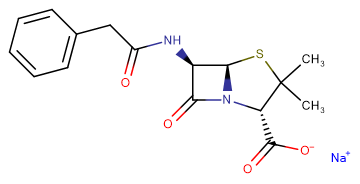
Penicillin G sodium salt
CAS No. 69-57-8
Penicillin G sodium salt( —— )
Catalog No. M15662 CAS No. 69-57-8
Benzylpenicillin sodium is a penicillin derivative commonly used in the form of its sodium or potassium salts in the treatment of a variety of infections.
Purity : >98% (HPLC)
 COA
Datasheet
HNMR
HPLC
MSDS
Handing Instructions
COA
Datasheet
HNMR
HPLC
MSDS
Handing Instructions
| Size | Price / USD | Stock | Quantity |
| 100MG | 44 | In Stock |


|
| 200MG | 63 | In Stock |
|
| 500MG | 104 | In Stock |
|
| 1G | Get Quote | In Stock |
|
Biological Information
-
Product NamePenicillin G sodium salt
-
NoteResearch use only, not for human use.
-
Brief DescriptionBenzylpenicillin sodium is a penicillin derivative commonly used in the form of its sodium or potassium salts in the treatment of a variety of infections.
-
DescriptionBenzylpenicillin sodium is a penicillin derivative commonly used in the form of its sodium or potassium salts in the treatment of a variety of infections. It is effective against most gram-positive bacteria and against gram-negative cocci. It has also been used as an experimental convulsant because of its actions on gamma-aminobutyric acid mediated synaptic transmission.(In Vitro):The Ultraviolet-visible (UV-Vis) absorption spectrum of the Penicillin G sodium salt-TEM-1 system is markedly different to that of Penicillin G sodium salt and TEM-1 β-lactamase, indicating the formation of new complexes between Penicillin G sodium salt and TEM-1 β-lactamase. The UV-Vis absorption of TEM-1 β-lactamase increases and a slight red-shift occurs as the concentration of Penicillin G sodium salt increasing, indicating that the interaction between Penicillin G sodium salt and TEM-1 β-lactamase results in subtle conformational changes of TEM-1 β-lactamase.(In Vivo):In the logistic regression model, the probability of a positive swab in the control group is 1.6 times higher than that in the pigs treated with Penicillin G sodium salt (P<0.05). In the control group, the risk of a swab having 10 to 99 colonies per plate, compare to having zero per plate, is 2.3 times greater than that in the pigs treated with Penicillin G sodium salt (P=0.022).
-
In VitroThe Ultraviolet-visible (UV-Vis) absorption spectrum of the Penicillin G sodium salt-TEM-1 system is markedly different to that of Penicillin G sodium salt and TEM-1 β-lactamase, indicating the formation of new complexes between Penicillin G sodium salt and TEM-1 β-lactamase. The UV-Vis absorption of TEM-1 β-lactamase increases and a slight red-shift occurs as the concentration of Penicillin G sodium salt increasing, indicating that the interaction between Penicillin G sodium salt and TEM-1 β-lactamase results in subtle conformational changes of TEM-1 β-lactamase.
-
In VivoIn the logistic regression model, the probability of a positive swab in the control group is 1.6 times higher than that in the pigs treated with Penicillin G sodium salt (P<0.05). In the control group, the risk of a swab having 10 to 99 colonies per plate, compare to having zero per plate, is 2.3 times greater than that in the pigs treated with Penicillin G sodium salt (P=0.022).
-
Synonyms——
-
PathwayGPCR/G Protein
-
TargetAntibacterial
-
RecptorPBPs| GABAR
-
Research AreaOther Indications
-
Indication——
Chemical Information
-
CAS Number69-57-8
-
Formula Weight356.37
-
Molecular FormulaC16H17N2NaO4S
-
Purity>98% (HPLC)
-
SolubilityWater: 71 mg/mL (199.23 mM); DMSO: 71 mg/mL (199.23 mM)
-
SMILESCC1([C@@H](N2[C@H](S1)[C@@H](C2=O)NC(=O)CC3=CC=CC=C3)C(=O)[O-])C.[Na+]
-
Chemical Name——
Shipping & Storage Information
-
Storage(-20℃)
-
ShippingWith Ice Pack
-
Stability≥ 2 years
Reference
1.Jiang X, et al. Spectrochim Acta A Mol Biomol Spectrosc. 2015 Apr 5;140:474-8.
molnova catalog



related products
-
Meropenem trihydrate
Meropenem trihydrate with broad-spectrum antibacterial activity,is a carbapenem antibiotic.
-
Melitracen hydrochlo...
Melitracen Hydrochloride, an antidepressant, is used as potential dopamine D1/2 receptor antagonist to treat depression.
-
J8-C8
J8-C8 is a small-molecule inhibitor of bacterial N-acyl-homoserine lactone synthase (acyl-HSLs) TofI with IC50 of 35 uM for toxoflavin production.
