


 Cart
Cart
 sales@molnova.com



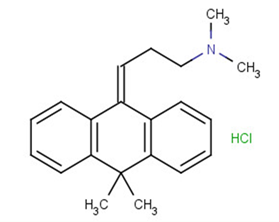
Melitracen hydrochloride
CAS No. 10563-70-9
Melitracen hydrochloride( N 7001 | N7001 | N-7001 | Melitracen HCl )
Catalog No. M17786 CAS No. 10563-70-9
Melitracen Hydrochloride, an antidepressant, is used as potential dopamine D1/2 receptor antagonist to treat depression.
Purity : >98% (HPLC)
 COA
Datasheet
HNMR
HPLC
MSDS
Handing Instructions
COA
Datasheet
HNMR
HPLC
MSDS
Handing Instructions
| Size | Price / USD | Stock | Quantity |
| 1 mL x 10 mM in DMSO | 41 | In Stock |


|
| 10MG | 37 | In Stock |
|
| 25MG | 59 | In Stock |
|
| 50MG | 83 | In Stock |
|
| 100MG | 110 | In Stock |
|
| 200MG | 161 | In Stock |
|
| 500MG | 272 | In Stock |
|
| 1G | Get Quote | In Stock |
|
Biological Information
-
Product NameMelitracen hydrochloride
-
NoteResearch use only, not for human use.
-
Brief DescriptionMelitracen Hydrochloride, an antidepressant, is used as potential dopamine D1/2 receptor antagonist to treat depression.
-
DescriptionMelitracen HCl ia potential dopamine D1/2 receptor antagonist used to treat depression. It is often co-administered with flupenthixol as a treatment for trigeminal neuralgia. It does not effect cardiovascular function.(In Vivo):Single oral administration of either Imipramine or Melitracen produces a marked and long lasting mydriasis in mice. The mydriatic effect of Melitracen is more marked and longer lasting. Melitracen is more effective with respect to behavioral excitement. Single oral administration of Melitracen produces lowering of the catechol amine levels in the brain stem, the cerebral cortex, the spleen, and the adrenals.No significant changes in catecholamine levels of the brain stem, the cerebral cortex, and the spleen were observed in rats receiving daily doses of Melitracen for 13 and 15 weeks. The adrenalin level in the adrenals, however, is slightly decreased.
-
In Vitro——
-
In VivoSingle oral administration of either Imipramine or Melitracen produces a marked and long lasting mydriasis in mice. The mydriatic effect of Melitracen is more marked and longer lasting. Melitracen is more effective with respect to behavioral excitement. Single oral administration of Melitracenproduces lowering of the catechol amine levels in the brain stem, the cerebral cortex, the spleen, and the adrenals. No significant changes in catecholamine levels of the brain stem, the cerebral cortex, and the spleen were observed in rats receiving daily doses of Melitracen for 13 and 15 weeks. The adrenalin level in the adrenals, however, is slightly decreased.
-
SynonymsN 7001 | N7001 | N-7001 | Melitracen HCl
-
PathwayGPCR/G Protein
-
TargetAntibacterial
-
RecptorD1|D2
-
Research Area——
-
Indication——
Chemical Information
-
CAS Number10563-70-9
-
Formula Weight327.9
-
Molecular FormulaC21H26ClN
-
Purity>98% (HPLC)
-
SolubilityIn Vitro:?H2O : 100 mg/mL (304.98 mM)
-
SMILESCl.CN(C)CC\C=C2/c1ccccc1C(C)(C)c3ccccc23
-
Chemical Name3-(10,10-dimethylanthracen-9(10H)-ylidene)-N,N-dimethylpropan-1-amine hydrochloride
Shipping & Storage Information
-
Storage(-20℃)
-
ShippingWith Ice Pack
-
Stability≥ 2 years
Reference
1.Kent JM.SNaRIs, NaSSAs, and NaRIs: new agents for the treatment of depression.Lancet. 2000 Mar 11;355(9207):911-8.
molnova catalog



related products
-
Clorophene
Clorophene is an antimicrobial agent and can be used in personal care products.
-
Chlormidazole hydroc...
Chlormidazole hydrochloride has inhibitory activity against many fungi and some gram-positive cocci.
-
AFN-1252
A potent inhibitor of bacterial enoyl-ACP reductase FabI.
