


 Cart
Cart
 sales@molnova.com



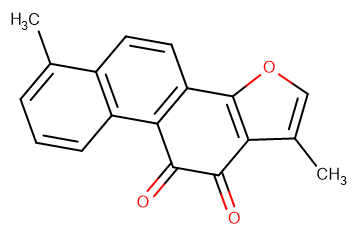
Tanshinone I
CAS No. 568-73-0
Tanshinone I( Tanshinone A )
Catalog No. M15071 CAS No. 568-73-0
Tanshinone I is a pigment isolated from the herbal medicine Salvia miltiorrhiza Bunge.
Purity : >98% (HPLC)
 COA
Datasheet
HNMR
HPLC
MSDS
Handing Instructions
COA
Datasheet
HNMR
HPLC
MSDS
Handing Instructions
| Size | Price / USD | Stock | Quantity |
| 5MG | 37 | In Stock |


|
| 10MG | 52 | In Stock |
|
| 25MG | 107 | In Stock |
|
| 50MG | 144 | In Stock |
|
| 100MG | 206 | In Stock |
|
| 200MG | Get Quote | In Stock |
|
| 500MG | 514 | In Stock |
|
| 1G | Get Quote | In Stock |
|
Biological Information
-
Product NameTanshinone I
-
NoteResearch use only, not for human use.
-
Brief DescriptionTanshinone I is a pigment isolated from the herbal medicine Salvia miltiorrhiza Bunge.
-
DescriptionTanshinone I is a pigment isolated from the herbal medicine Salvia miltiorrhiza Bunge. Tanshinone I displays cytotoxicity against human macrophages and IFN-g production in KLH-primed lymph node cells.(In Vitro):Tanshinone I inhibits PGE2 formation from LPS-induced RAW macrophages (IC50=38 μM). When Tanshinone I is added simultaneously with LPS, this compound clearly inhibits PGE2 production (IC50=38 μM) at 10-100 μM. Tanshinone I also reduces PGE2 production (IC50=46 μM) when added after COX-2 is fully induced. The fact that Tanshinone I inhibits PGE2 production by pre-induced COX-2 strongly suggests that this compound may directly inhibit COX-2 activity and/or affect PLA2 activity. When Tanshinone I is incubated with two different forms of phospholipase A2 (PLA2), it clearly inhibits sPLA2 (IC50=11 μM) in a concentration-dependent manner. Although being less potent, Tanshinone I also inhibits cPLA2 (IC50=82 μM). (In Vivo):Tanshinone I shows antiinflammatory activity in rat carrageenan-induced paw oedema and adjuvant-induced arthritis. In order to establish the anti-inflammatory activity of Tanshinone I, the classical animal models of acute and chronic inflammation [rat carrageenan (CGN)-induced paw oedema and rat adjuvant-induced arthritis (AIA)] are employed. When Tanshinone I is orally administered, it shows significant anti-inflammatory activity against CGN-induced paw oedema (47% inhibition at 160 mg/kg), while the IC50 of indomethacin is 7.1 mg/kg. In AIA, Tanshinone I gives 27% inhibition of secondary inflammation at 18 day with an oral dose of 50 mg/kg/day, whereas prednisolone (5 mg/kg/day) shows potent inhibition (65%).
-
In VitroTanshinone I inhibits PGE2 formation from LPS-induced RAW macrophages (IC50=38 μM). When Tanshinone I is added simultaneously with LPS, this compound clearly inhibits PGE2 production (IC50=38 μM) at 10-100 μM. Tanshinone I also reduces PGE2 production (IC50=46 μM) when added after COX-2 is fully induced. The fact that Tanshinone I inhibits PGE2 production by pre-induced COX-2 strongly suggests that this compound may directly inhibit COX-2 activity and/or affect PLA2 activity. When Tanshinone I is incubated with two different forms of phospholipase A2 (PLA2), it clearly inhibits sPLA2 (IC50=11 μM) in a concentration-dependent manner. Although being less potent, Tanshinone I also inhibits cPLA2 (IC50=82 μM).
-
In VivoTanshinone I shows antiinflammatory activity in rat carrageenan-induced paw oedema and adjuvant-induced arthritis. In order to establish the anti-inflammatory activity of Tanshinone I, the classical animal models of acute and chronic inflammation [rat carrageenan (CGN)-induced paw oedema and rat adjuvant-induced arthritis (AIA)] are employed. When Tanshinone I is orally administered, it shows significant anti-inflammatory activity against CGN-induced paw oedema (47% inhibition at 160 mg/kg), while the IC50 of indomethacin is 7.1 mg/kg. In AIA, Tanshinone I gives 27% inhibition of secondary inflammation at 18 day with an oral dose of 50 mg/kg/day, whereas prednisolone (5 mg/kg/day) shows potent inhibition (65%).
-
SynonymsTanshinone A
-
PathwayMetabolic Enzyme/Protease
-
TargetPhospholipase
-
RecptorPLA2
-
Research AreaMetabolic Disease
-
Indication——
Chemical Information
-
CAS Number568-73-0
-
Formula Weight276.29
-
Molecular FormulaC18H12O3
-
Purity>98% (HPLC)
-
SolubilityDMSO: 23 mg/mL (83.24 mM)
-
SMILESCC1=COC2=C1C(=O)C(=O)C1=C2C=CC2=C1C=CC=C2C
-
Chemical Name——
Shipping & Storage Information
-
Storage(-20℃)
-
ShippingWith Ice Pack
-
Stability≥ 2 years
Reference
1.Kim SY, et al. PhytOthers Res, 2002, 16(7), 616-620.
molnova catalog



related products
-
CAY10594
CAY10594 is a potent phospholipase D2(PLD2) inhibitor. CAY10594 ameliorates acetaminophen-induced acute liver injury by regulating the phosphorylated-GSK-3β/JNK axis.
-
IACS-13909
IACS-13909, a specific and potent allosteric inhibitor of SHP2, that suppresses signaling through the MAPK pathway.
-
Efipladib
Efipladib (PLA 902) is a potent, selective and orally active inhibitor of cPLA2α with IC50 of 20 nM for LTB4 inhibition.
