


 Cart
Cart
 sales@molnova.com



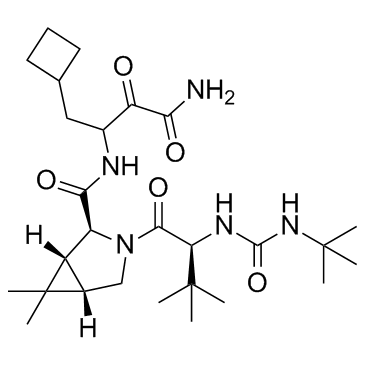
Boceprevir
CAS No. 394730-60-0
Boceprevir( EBP 520 | SCH 503034 | EBP-520 | EBP520 | SCH-503034 | SCH503034 )
Catalog No. M14358 CAS No. 394730-60-0
A potent, selective, orally bioavailable HCV NS3 protease with Ki of 14 nM, EC90 of 350 nM in cell replicon assays.
Purity : >98% (HPLC)
 COA
Datasheet
HNMR
HPLC
MSDS
Handing Instructions
COA
Datasheet
HNMR
HPLC
MSDS
Handing Instructions
| Size | Price / USD | Stock | Quantity |
| 5MG | 59 | In Stock |


|
| 10MG | 88 | In Stock |
|
| 25MG | 138 | In Stock |
|
| 50MG | 177 | In Stock |
|
| 100MG | 286 | In Stock |
|
| 200MG | Get Quote | In Stock |
|
| 500MG | Get Quote | In Stock |
|
| 1G | Get Quote | In Stock |
|
Biological Information
-
Product NameBoceprevir
-
NoteResearch use only, not for human use.
-
Brief DescriptionA potent, selective, orally bioavailable HCV NS3 protease with Ki of 14 nM, EC90 of 350 nM in cell replicon assays.
-
DescriptionA potent, selective, orally bioavailable HCV NS3 protease with Ki of 14 nM, EC90 of 350 nM in cell replicon assays; displays >2000-fold selectivity over human neutrophil elastase (HNE).HCV Infection Approved(In Vitro):In the HCV NS3 protease continuous assay, Boceprevir (SCH 503034) has a potency of 14 nM (Ki) average over a large number of runs. In the 72-h bicistronic subgenomic cell-based replicon assay in HuH-7 cells, the EC50 and EC90 values are determined to be 0.20 μM and 0.35 μM, respectively. Boceprevir is also found to be a very weak inhibitor of HNE (Ki=26 μM) representing a selectivity of 2200. (In Vivo):Boceprevir, an HCV Protease Inhibitor for the Treatment of Hepatitis C Virus Infection. The pharmacokinetic profile of Boceprevir is evaluated in several animal species. Following oral administration, Boceprevir is moderately absorbed in rats (10 mg/kg), dogs (3 mg/kg), and monkeys (3 mg/kg). Absorption is relatively rapid in dogs but slower in mice (10 mg/kg), rats, and monkeys, as evidenced by mean absorption times (MAT) ranging from 0.5 to 1.4 h. The AUC is good in dogs and rats, moderate in mouse, and low in monkeys. The absolute oral bioavailability is modest in mouse, rats, and dogs (26-34%) but low in monkeys (4%). Boceprevir (100 mg/kg, orally) inhibit HCV NS3/4A protease activity in triple-transgenic mice.
-
In Vitro——
-
In Vivo——
-
SynonymsEBP 520 | SCH 503034 | EBP-520 | EBP520 | SCH-503034 | SCH503034
-
PathwayMicrobiology/Virology
-
TargetHCV
-
RecptorHCVNS3protease
-
Research AreaInfection
-
IndicationHCV Infection
Chemical Information
-
CAS Number394730-60-0
-
Formula Weight519.6767
-
Molecular FormulaC27H45N5O5
-
Purity>98% (HPLC)
-
SolubilityDMSO: ≥ 10 mg/mL
-
SMILESO=C([C@@H]1[C@@]2([H])C(C)(C)[C@@]2([H])CN1C([C@@H](NC(NC(C)(C)C)=O)C(C)(C)C)=O)NC(C(C(N)=O)=O)CC3CCC3
-
Chemical Name3-Azabicyclo[3.1.0]hexane-2-carboxamide, N-[3-amino-1-(cyclobutylmethyl)-2,3-dioxopropyl]-3-[(2S)-2-[[[(1,1-dimethylethyl)amino]carbonyl]amino]-3,3-dimethyl-1-oxobutyl]-6,6-dimethyl-, (1R,2S,5S)-
Shipping & Storage Information
-
Storage(-20℃)
-
ShippingWith Ice Pack
-
Stability≥ 2 years
Reference
1. Venkatraman S, et al. J Med Chem. 2006 Oct 5;49(20):6074-86.
2. Sarrazin C, et al. Gastroenterology. 2007 Apr;132(4):1270-8.
3. Flint M, et al. Antimicrob Agents Chemother. 2009 Feb;53(2):401-11.
molnova catalog



related products
-
BLT-1
BLT-1 is a scavenger receptor BI (SR-BI)inhibitor.BLT-1 has IC50s of 60 and 110 nM for cellular DiI-HDL and [3H]CE-HDL uptake in ldlA[mSR-BI] cells.
-
KIN101
KIN101, an isoflavone agonist of IRF-3 dependent signaling, induces IRF-3 nuclear translocation. KIN101 has antiviral activity against RNA viruses, HCV, and RSV.
-
Radalbuvir
Radalbuvir (GS-9669) is a highly optimized thumb site II nonnucleoside inhibitor of HCV NS5B polymerase with binding affinity of 1.35 nM for genotype 1b.
