


 Cart
Cart
 sales@molnova.com



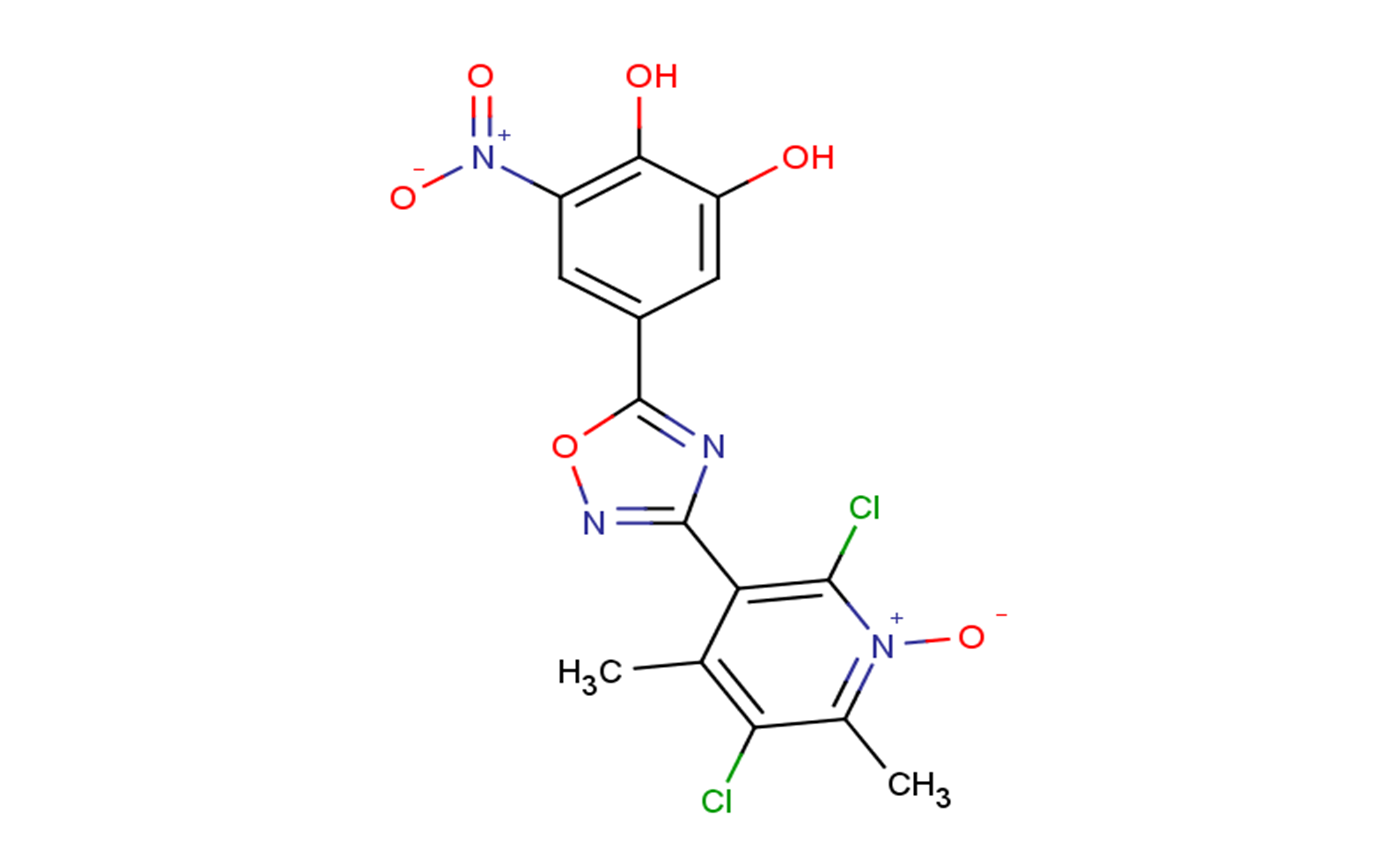
Opicapone
CAS No. 923287-50-7
Opicapone( BIA 9-1067 )
Catalog No. M24972 CAS No. 923287-50-7
Opicapone reduces the ATP content of the cells (IC50: 98 μM).
Purity : >98% (HPLC)
 COA
Datasheet
HNMR
HPLC
MSDS
Handing Instructions
COA
Datasheet
HNMR
HPLC
MSDS
Handing Instructions
| Size | Price / USD | Stock | Quantity |
| 2MG | 77 | In Stock |


|
| 5MG | 129 | In Stock |
|
| 10MG | 219 | In Stock |
|
| 25MG | 401 | In Stock |
|
| 50MG | 592 | In Stock |
|
| 100MG | 844 | In Stock |
|
| 200MG | Get Quote | In Stock |
|
| 500MG | Get Quote | In Stock |
|
| 1G | Get Quote | In Stock |
|
Biological Information
-
Product NameOpicapone
-
NoteResearch use only, not for human use.
-
Brief DescriptionOpicapone reduces the ATP content of the cells (IC50: 98 μM).
-
DescriptionOpicapone reduces the ATP content of the cells (IC50: 98 μM). Opicapone is an effective third-generation catechol-O-methyltransferase inhibitor for the research of Parkinson's disease and motor fluctuations. (In Vitro):Opicapone has a prolonged inhibitory effect on peripheral COMT, which extends the bioavailability of L-DOPA, without inducing toxicity. Opicapone decreases the ATP content of the cells with IC50 values of 98 μM. Incubation of human primary hepatocytes for 24 h with increasing concentrations of Ro 40-7592, OR-611 or Opicapone resulted in a concentration-dependent decrease in the mitochondrial membrane potential of the cells, evaluated by the ratio JC-1 aggregates over JC-1 monomer (ratio λex 544 λem 590 over λex 485 λem 538). Opicapone decreases the mitochondrial membrane potential of the cells with IC50 of 181 μM.(In Vivo):Opicapone inhibits rat peripheral COMT with ED50 values below 1.4 mg/kg up to 6 h post-administration. The effect is sustained over the first 8 h and by 24 h COMT had not returned to control values. A single administration of Opicapone resulted in increased and sustained plasma L-DOPA levels with a concomitant reduction in 3-OMD from 2 h up to 24 h post-administration, while Ro 40-7592 produces significant effects only at 2 h post-administration. The effects of Opicapone on brain catecholamines after L-DOPA administration are sustained up to 24 h post-administration. Opicapone is also the least potent compound in decreasing both the mitochondrial membrane potential and the ATP content in human primary hepatocytes after a 24 h incubation period.
-
In VitroOpicapone has a prolonged inhibitory effect on peripheral COMT, which extends the bioavailability of L-DOPA, without inducing toxicity. Opicapone decreases the ATP content of the cells with IC50 values of 98 μM. Incubation of human primary hepatocytes for 24 h with increasing concentrations of Ro 40-7592, OR-611 or Opicapone resulted in a concentration-dependent decrease in the mitochondrial membrane potential of the cells, evaluated by the ratio JC-1 aggregates over JC-1 monomer (ratio λex 544 λem 590 over λex 485 λem 538). Opicapone decreases the mitochondrial membrane potential of the cells with IC50 of 181 μM.
-
In VivoOpicapone inhibits rat peripheral COMT with ED50 values below 1.4 mg/kg up to 6 h post-administration. The effect is sustained over the first 8 h and by 24 h COMT had not returned to control values. A single administration of Opicapone resulted in increased and sustained plasma L-DOPA levels with a concomitant reduction in 3-OMD from 2 h up to 24 h post-administration, while Ro 40-7592 produces significant effects only at 2 h post-administration. The effects of Opicapone on brain catecholamines after L-DOPA administration are sustained up to 24 h post-administration. Opicapone is also the least potent compound in decreasing both the mitochondrial membrane potential and the ATP content in human primary hepatocytes after a 24 h incubation period.
-
SynonymsBIA 9-1067
-
PathwayMetabolic Enzyme/Protease
-
TargetTransferase
-
RecptorCOMT
-
Research Area——
-
Indication——
Chemical Information
-
CAS Number923287-50-7
-
Formula Weight413.17
-
Molecular FormulaC15H10Cl2N4O6
-
Purity>98% (HPLC)
-
SolubilityDMSO:100 mg/mL (242.03 mM; Need ultrasonic)
-
SMILESOC1=CC(C2=NC(C3=C(Cl)[N+]([O-])=C(C)C(Cl)=C3C)=NO2)=CC([N+]([O-])=O)=C1O
-
Chemical Name——
Shipping & Storage Information
-
Storage(-20℃)
-
ShippingWith Ice Pack
-
Stability≥ 2 years
Reference
1.Bonifácio MJ, et al. Pharmacological profile of Opicapone, a third-generation nitrocatechol catechol-O-methyl transferase inhibitor, in the rat. Br J Pharmacol. 2015 Apr;172(7):1739-52.
molnova catalog



related products
-
G43
G43 is a potent and selective glucosyltransferase inhibitor that inhibits GtfB and GtfC with Kd values of 3.7 μM and 46.9 nM, respectively.
-
Entacapone acid
Entacapone is a selective and reversible inhibitor of catechol-O-methyltransferase(COMT).
-
FGTI-2734
FGTI-2734 can prevent membrane localization of KRAS, hence solving KRAS resistance problem and thwarting mutant KRAS patient-derived pancreatic tumors.?
