


 Cart
Cart
 sales@molnova.com



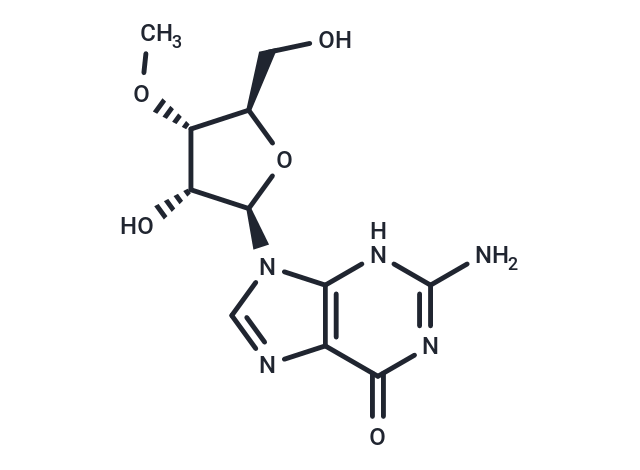
3’-O-Methyl guanosine
CAS No. 10300-27-3
3’-O-Methyl guanosine( —— )
Catalog No. M37881 CAS No. 10300-27-3
Nucleoside Derivatives –3’-Modified nucleoside
Purity : >98% (HPLC)
 COA
Datasheet
HNMR
HPLC
MSDS
Handing Instructions
COA
Datasheet
HNMR
HPLC
MSDS
Handing Instructions
| Size | Price / USD | Stock | Quantity |
| 10MG | 31 | In Stock |


|
| 25MG | 55 | In Stock |
|
| 50MG | 86 | In Stock |
|
| 100MG | 124 | In Stock |
|
| 200MG | 183 | In Stock |
|
| 500MG | Get Quote | In Stock |
|
| 1G | Get Quote | In Stock |
|
Biological Information
-
Product Name3’-O-Methyl guanosine
-
NoteResearch use only, not for human use.
-
Brief DescriptionNucleoside Derivatives –3’-Modified nucleoside
-
Description3'-O-Methylguanosine is a methylated nucleoside analogs and a RNA chain terminator. 3'-O-methylguanosine can inhibit early virus-specific RNA synthesis.
-
In Vitro——
-
In Vivo——
-
Synonyms——
-
PathwayProteasome/Ubiquitin
-
TargetEndogenous Metabolite
-
RecptorEndogenous Metabolite
-
Research Area——
-
Indication——
Chemical Information
-
CAS Number10300-27-3
-
Formula Weight297.27
-
Molecular FormulaC11H15N5O5
-
Purity>98% (HPLC)
-
SolubilityIn Vitro:?DMSO : 25 mg/mL (84.10 mM; Ultrasonic (<60°C)
-
SMILESCO[C@@H]1[C@@H](CO)O[C@H]([C@@H]1O)n1cnc2c1[nH]c(N)nc2=O
-
Chemical Name——
Shipping & Storage Information
-
Storage(-20℃)
-
ShippingWith Ice Pack
-
Stability≥ 2 years
Reference
1. B B Goswami, et al. Inhibition of vaccinia virus growth and virus-specific RNA synthesis by 3'-O-methyl adenosine and 3'-O-methyl guanosine. J Virol. 1983 Mar;45(3):1164-7.?
molnova catalog



related products
-
3-Hydroxybutyric aci...
3-Hydroxybutyric acid sodium (β-Hydroxybutyric acid sodium) is a metabolite found in type I diabetic patients that regulates membrane lipids.
-
4-Hydroxycyclohexane...
4-Hydroxycyclohexanecarboxylic acid is a substrate of cyclohexanecarboxylic acid and is isolated from olive brine.
-
(Ethoxymethyl)benzen...
(Ethoxymethyl)benzene is a human endogenous metabolite.
