


 Cart
Cart
 sales@molnova.com



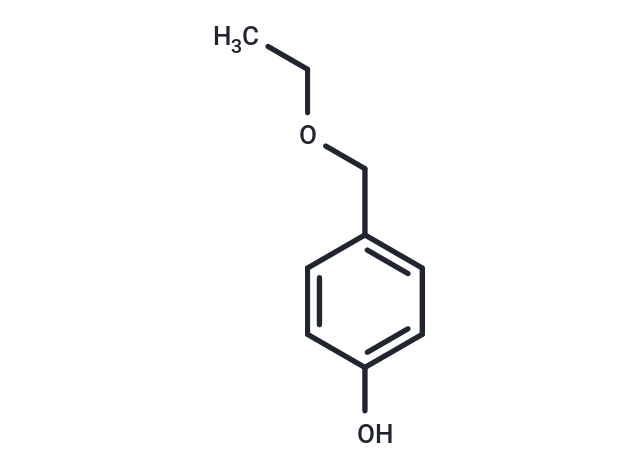
4-(Ethoxymethyl)phenol
CAS No. 57726-26-8
4-(Ethoxymethyl)phenol( —— )
Catalog No. M37754 CAS No. 57726-26-8
4-(Ethoxymethyl)phenol (p-Hydroxybenzyl Et ether) is a small molecule extracted from Amburana cearensis, exhibiting cytotoxic and antioxidant activities.
Purity : >98% (HPLC)
 COA
Datasheet
HNMR
HPLC
MSDS
Handing Instructions
COA
Datasheet
HNMR
HPLC
MSDS
Handing Instructions
| Size | Price / USD | Stock | Quantity |
| 1 mL x 10 mM in DMSO | 71 | In Stock |


|
| 5MG | 89 | In Stock |
|
| 10MG | 130 | In Stock |
|
| 25MG | 221 | In Stock |
|
| 50MG | 319 | In Stock |
|
| 100MG | 454 | In Stock |
|
| 200MG | 603 | In Stock |
|
| 500MG | Get Quote | In Stock |
|
| 1G | Get Quote | In Stock |
|
Biological Information
-
Product Name4-(Ethoxymethyl)phenol
-
NoteResearch use only, not for human use.
-
Brief Description4-(Ethoxymethyl)phenol (p-Hydroxybenzyl Et ether) is a small molecule extracted from Amburana cearensis, exhibiting cytotoxic and antioxidant activities.
-
Description4-(Ethoxymethyl)phenol (p-Hydroxybenzyl Et ether) is a potent antioxidant from Amburana cearensis leaf extract, with in vitro cytogenotoxic properties. Amburana cearensis leaves can be used foe the research of respiratory diseases and inflammations.
-
In Vitro——
-
In Vivo——
-
Synonyms——
-
PathwayOthers
-
TargetAntioxidant
-
RecptorAntioxidant
-
Research Area——
-
Indication——
Chemical Information
-
CAS Number57726-26-8
-
Formula Weight152.19
-
Molecular FormulaC9H12O2
-
Purity>98% (HPLC)
-
Solubility——
-
SMILESCCOCC1=CC=C(O)C=C1
-
Chemical Name——
Shipping & Storage Information
-
Storage(-20℃)
-
ShippingWith Ice Pack
-
Stability≥ 2 years
Reference
1. José Rafael da Silva Araujo, et al. Antioxidant and in vitro cytogenotoxic properties of Amburana cearensis (Allem?o) A.C.Sm. leaf extract. Drug Chem Toxicol. 2021 Dec 14;1-9.?
molnova catalog



related products
-
BMY 7378 dihydrochlo...
BMY-7378, α1D-adrenergic receptor antagonist, is a weak partial agonist/antagonist of 5-HT1A receptor.
-
NSC 31150
NSC 31150 is a potential PPAR agonist with antibacterial, antidiabetic and antioxidant activities and may be used to study cancer and bacterial infections.
-
Theaflavin 33'-digal...
8-Gingerol (TFDG) a major polyphenol found in black tea is an inducer of oxidative stress which has anti-inflammatory and cancer chemopreventive actions it reduces tumor angiogenesis by downregulating HIF-1αand VEGF.
