


 Cart
Cart
 sales@molnova.com



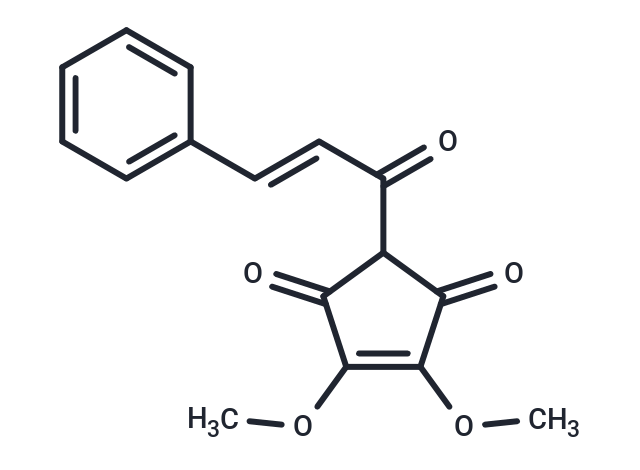
Linderone
CAS No. 1782-79-2
Linderone( —— )
Catalog No. M37737 CAS No. 1782-79-2
Linderone, a compound isolated from Lindera erythrocarpa, has antioxidant and anti-inflammatory activity and can be used to study neuroinflammation.
Purity : >98% (HPLC)
 COA
Datasheet
HNMR
HPLC
MSDS
Handing Instructions
COA
Datasheet
HNMR
HPLC
MSDS
Handing Instructions
| Size | Price / USD | Stock | Quantity |
| 1 mL x 10 mM in DMSO | 1205 | Get Quote |


|
| 2MG | 540 | Get Quote |
|
| 5MG | 758 | Get Quote |
|
| 100MG | Get Quote | Get Quote |
|
| 200MG | Get Quote | Get Quote |
|
| 500MG | Get Quote | Get Quote |
|
| 1G | Get Quote | Get Quote |
|
Biological Information
-
Product NameLinderone
-
NoteResearch use only, not for human use.
-
Brief DescriptionLinderone, a compound isolated from Lindera erythrocarpa, has antioxidant and anti-inflammatory activity and can be used to study neuroinflammation.
-
DescriptionLinderone is an antioxidant agent.
-
In Vitro——
-
In Vivo——
-
Synonyms——
-
PathwayOthers
-
TargetAntioxidant
-
RecptorAntioxidant
-
Research Area——
-
Indication——
Chemical Information
-
CAS Number1782-79-2
-
Formula Weight286.28
-
Molecular FormulaC16H14O5
-
Purity>98% (HPLC)
-
Solubility——
-
SMILESC(/C=C/C1=CC=CC=C1)(=O)C2C(=O)C(OC)=C(OC)C2=O
-
Chemical Name——
Shipping & Storage Information
-
Storage(-20℃)
-
ShippingWith Ice Pack
-
Stability≥ 2 years
Reference
1. Mwadham M. Kabanda, et al. Conformational, electronic and antioxidant properties of lucidone, linderone and methyllinderone: DFT, QTAIM and NBO studies.
molnova catalog



related products
-
N-Arachidonylglycine
N-Arachidonylglycine (NA-Gly) is a heat-dependent circulating metabolite with anti-inflammatory, anticancer, antidiabetic and antioxidant activities.
-
Ethyl pyruvate
Ethyl pyruvate is a simple aliphatic ester of pyruvic acid and has been shown to have robust neuroprotective effects via its anti-inflammatory anti-oxidative and anti-apoptotic functions.
-
7-Hydroxycoumarin
It is a widespread natural product of the coumarin family. It has been reported to have antioxidant properties.
