


 Cart
Cart
 sales@molnova.com



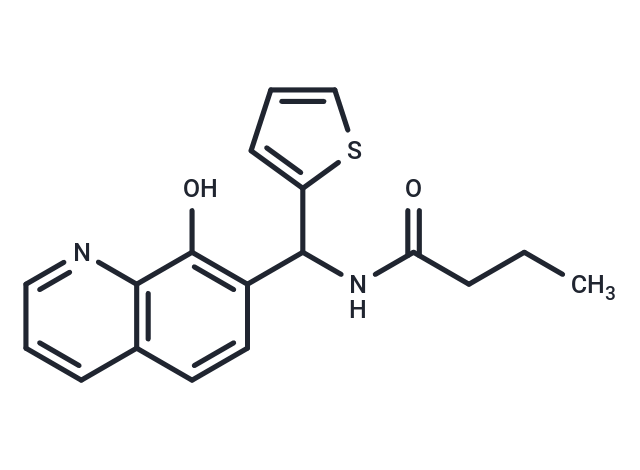
WAY-322243
CAS No. 332939-32-9
WAY-322243( —— )
Catalog No. M36995 CAS No. 332939-32-9
WAY-322243 has antibacterial and anti-inflammatory activity and has an inhibitory effect on CLK-1, which can be used to study Alzheimer's disease.
Purity : >98% (HPLC)
 COA
Datasheet
HNMR
HPLC
MSDS
Handing Instructions
COA
Datasheet
HNMR
HPLC
MSDS
Handing Instructions
| Size | Price / USD | Stock | Quantity |
| 2MG | 33 | In Stock |


|
| 5MG | 51 | In Stock |
|
| 10MG | 84 | In Stock |
|
| 25MG | 177 | In Stock |
|
| 50MG | 259 | In Stock |
|
| 100MG | 393 | In Stock |
|
| 200MG | Get Quote | In Stock |
|
| 500MG | 890 | In Stock |
|
| 1G | Get Quote | In Stock |
|
Biological Information
-
Product NameWAY-322243
-
NoteResearch use only, not for human use.
-
Brief DescriptionWAY-322243 has antibacterial and anti-inflammatory activity and has an inhibitory effect on CLK-1, which can be used to study Alzheimer's disease.
-
DescriptionWAY-322243 has antibacterial and anti-inflammatory activity and has an inhibitory effect on CLK-1, which can be used to study Alzheimer's disease.
-
In Vitro——
-
In Vivo——
-
Synonyms——
-
PathwayCell Cycle/DNA Damage
-
TargetCDK
-
RecptorCDK
-
Research Area——
-
Indication——
Chemical Information
-
CAS Number332939-32-9
-
Formula Weight326.41
-
Molecular FormulaC18H18N2O2S
-
Purity>98% (HPLC)
-
Solubility——
-
SMILESC(NC(CCC)=O)(C1=C(O)C2=C(C=C1)C=CC=N2)C3=CC=CS3
-
Chemical Name——
Shipping & Storage Information
-
Storage(-20℃)
-
ShippingWith Ice Pack
-
Stability≥ 2 years
Reference
molnova catalog



related products
-
Palbociclib hydrochl...
A potent and selective inhibitor of CDK4/6 with IC50 of 11 nM/16 nM; no inhibition for CDK2A (IC50>5 uM); inhibits MDA-MB453 cells with IC50 of 0.16 uM.
-
CDK5-IN-3
CDK5-IN-3 is a selective and potent CDK5 inhibitor that inhibits CDK5/p25 and CDK2/CycA and can be used in the study of cancer.
-
A-674563 HCl (552325...
A-674563 is an orally available, ATP-competitive, and reversible inhibitor of Akt (Ki: 11 nM for Akt1) .
