


 Cart
Cart
 sales@molnova.com



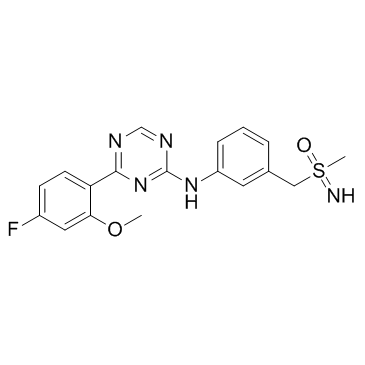
Atuveciclib
CAS No. 1414943-88-6
Atuveciclib( BAY 1143572 | BAY1143572 )
Catalog No. M11720 CAS No. 1414943-88-6
Atuveciclib (BAY-1143572) is a potent, highly selective, orally bioavailable CDK9/P-TEFb inhibitor with IC50 of 6 nM for CDK9/CyclinT1.
Purity : >98% (HPLC)
 COA
Datasheet
HNMR
HPLC
MSDS
Handing Instructions
COA
Datasheet
HNMR
HPLC
MSDS
Handing Instructions
| Size | Price / USD | Stock | Quantity |
| 1 mL x 10 mM in DMSO | 223 | In Stock |


|
| 2MG | 117 | In Stock |
|
| 5MG | 202 | In Stock |
|
| 10MG | 330 | In Stock |
|
| 25MG | 613 | In Stock |
|
| 50MG | 799 | In Stock |
|
| 100MG | 1097 | In Stock |
|
| 200MG | Get Quote | In Stock |
|
| 500MG | Get Quote | In Stock |
|
| 1G | Get Quote | In Stock |
|
Biological Information
-
Product NameAtuveciclib
-
NoteResearch use only, not for human use.
-
Brief DescriptionAtuveciclib (BAY-1143572) is a potent, highly selective, orally bioavailable CDK9/P-TEFb inhibitor with IC50 of 6 nM for CDK9/CyclinT1.
-
DescriptionAtuveciclib (BAY-1143572) is a potent, highly selective, orally bioavailable CDK9/P-TEFb inhibitor with IC50 of 6 nM for CDK9/CyclinT1; displays >150-fold selectivity over CDK1/2/3/5/6/7 (IC50>800 nM), also shows submicromolar inhibitory activity against GSK3α (IC50=45 nM), GSK3β (IC50=87 nM); demonstrates antiproliferative activity against HeLa cells (IC50=920 nM) and MOLM‐13 cells (IC50=310 nM); exhibits anticancer activity in human AML models.Blood Cancer Phase 1 Clinical.
-
In VitroAtuveciclib (BAY-1143572) inhibits the proliferation of 7 MLL-rearrangements positive and negative AML cell lines with a median IC50 of 385 nM (range 230-1100 nM) and induces apoptosis. Atuveciclib (BAY-1143572) has potent and highly selective PTEFb-kinase inhibitory activity in the low nanomolar range against PTEFb/CDK9 and an at least 50-fold selectivity against other CDKs. Atuveciclib (BAY-1143572) shows a favorable selectivity against a panel of non-CDK kinases. It shows broad antiproliferative activity against a panel of tumor cell lines with sub-micromolar IC50 values. The concentration-dependent inhibition of the phosphorylation of the RNA polymerase II and downstream reduction of MYC mRNA and protein levels is observed.
-
In VivoAtuveciclib (BAY-1143572) exhibits single agent efficacy at tolerated doses in 4 out of 5 AML xenograft tumor models in mice and in 2 out of 2 AML xenograft tumor models in rats upon once daily oral administration. Partial or even complete remissions could be achieved in several models.The inhibition of MYC mRNA is also observed in blood cells of Atuveciclib (BAY-1143572)-treated rats indicating the potential clinical utility of MYC in blood cells as a pharmacodynamic marker in clinical development. The in vivo efficacy of Atuveciclib (BAY-1143572) is significantly enhanced in combination with several chemotherapeutics in different solid tumor models.
-
SynonymsBAY 1143572 | BAY1143572
-
PathwayCell Cycle/DNA Damage
-
TargetCDK
-
RecptorCDK
-
Research AreaCancer
-
IndicationBlood cancer
Chemical Information
-
CAS Number1414943-88-6
-
Formula Weight387.433
-
Molecular FormulaC18H18FN5O2S
-
Purity>98% (HPLC)
-
SolubilityIn Vitro:?DMSO : 100 mg/mL (258.11 mM)
-
SMILESO=S(C)(CC1=CC=CC(NC2=NC(C3=CC=C(F)C=C3OC)=NC=N2)=C1)=N
-
Chemical Name(3-((4-(4-fluoro-2-methoxyphenyl)-1,3,5-triazin-2-yl)amino)benzyl)(imino)(methyl)-l6-sulfanone
Shipping & Storage Information
-
Storage(-20℃)
-
ShippingWith Ice Pack
-
Stability≥ 2 years
Reference
1. Lücking U, et al. ChemMedChem. 2017 Nov 8;12(21):1776-1793.
2. Narita T, et al. Blood. 2017 Aug 31;130(9):1114-1124.
molnova catalog



related products
-
SNS-032
SNS-032 (BMS-387032)?is a potent and selective inhibitor of CDK 2/7/9 with IC50 of 48 nM/62 nM/4 nM, respectively.
-
CDK5-IN-3
CDK5-IN-3 is a selective and potent CDK5 inhibitor that inhibits CDK5/p25 and CDK2/CycA and can be used in the study of cancer.
-
(S)-Enitociclib
(S)-Enitociclib (VIP152) is a selective CDK9 inhibitor that induces complete regression of MYC+ lymphomas by inhibiting RNA polymerase II-mediated transcription of anti-apoptotic and pro-survival proteins.
