


 Cart
Cart
 sales@molnova.com



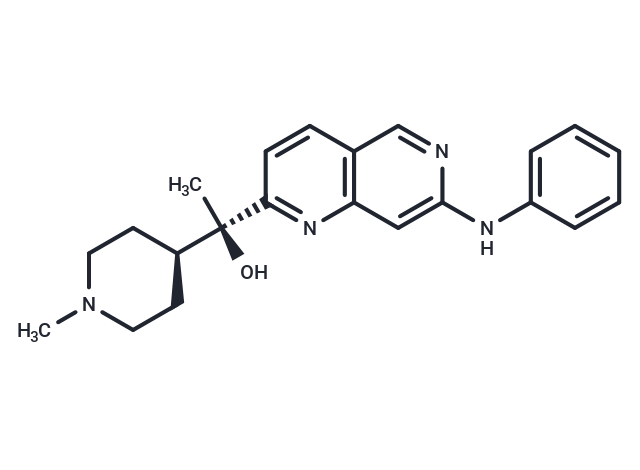
CDK5-IN-3
CAS No. 2639542-32-6
CDK5-IN-3( —— )
Catalog No. M35550 CAS No. 2639542-32-6
CDK5-IN-3 is a selective and potent CDK5 inhibitor that inhibits CDK5/p25 and CDK2/CycA and can be used in the study of cancer.
Purity : >98% (HPLC)
 COA
Datasheet
HNMR
HPLC
MSDS
Handing Instructions
COA
Datasheet
HNMR
HPLC
MSDS
Handing Instructions
| Size | Price / USD | Stock | Quantity |
| 1 mL x 10 mM in DMSO | 128 | In Stock |


|
| 5MG | 117 | In Stock |
|
| 10MG | 188 | In Stock |
|
| 25MG | 432 | In Stock |
|
| 100MG | Get Quote | In Stock |
|
| 200MG | Get Quote | In Stock |
|
| 500MG | Get Quote | In Stock |
|
| 1G | Get Quote | In Stock |
|
Biological Information
-
Product NameCDK5-IN-3
-
NoteResearch use only, not for human use.
-
Brief DescriptionCDK5-IN-3 is a selective and potent CDK5 inhibitor that inhibits CDK5/p25 and CDK2/CycA and can be used in the study of cancer.
-
DescriptionCDK5-IN-3 (compound 11) is a potent and selective CDK5 inhibitor, with IC50s of 0.6 nM and 18 nM for CDK5/p25 and CDK2/CycA, respectively. CDK5-IN-3 can be used for the research of autosomal dominant polycystic kidney disease (ADPKD).
-
In Vitro——
-
In Vivo——
-
Synonyms——
-
PathwayCell Cycle/DNA Damage
-
TargetCDK
-
RecptorCDK
-
Research Area——
-
Indication——
Chemical Information
-
CAS Number2639542-32-6
-
Formula Weight362.47
-
Molecular FormulaC22H26N4O
-
Purity>98% (HPLC)
-
SolubilityIn Vitro:?DMSO : 10 mg/mL (27.59 mM; Ultrasonic )
-
SMILES[C@](C)(O)(C1=NC2=C(C=C1)C=NC(NC3=CC=CC=C3)=C2)[C@H]4CCN(C)CC4
-
Chemical Name——
Shipping & Storage Information
-
Storage(-20℃)
-
ShippingWith Ice Pack
-
Stability≥ 2 years
Reference
1. Discovery and Optimization of Highly Selective Inhibitors of CDK5. J Med Chem. 2022 Feb 24;65(4):3575-3596.?
molnova catalog



related products
-
T025
T025 is a pan CLK inhibitor with Kds of 4.8, 0.096, 6.5, 0.61, and 0.074 nM for CLK1-4, respectively.
-
Flavopiridol
A potent, ATP-competetive CDKs inhibitor with IC50 of 30, 170, 100 nM for CDk1, 2, 4, respectively.
-
CDK-IN-10
CDK-IN-10 is a cell cycle protein-dependent kinase (CDK) inhibitor with potential anticancer activity for cancer research.
