


 Cart
Cart
 sales@molnova.com



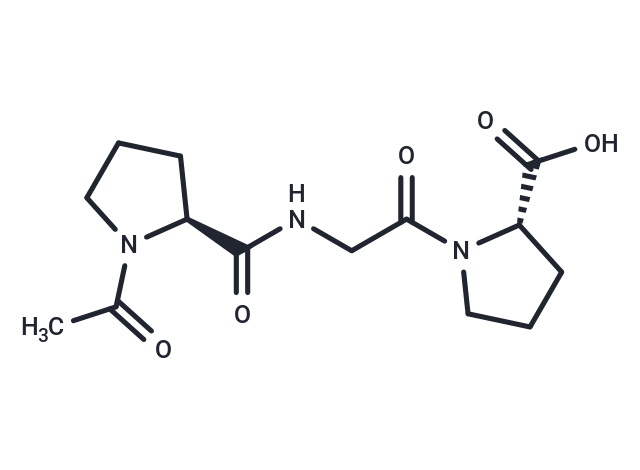
Ac-Pro-Gly-Pro-OH
CAS No. 292171-04-1
Ac-Pro-Gly-Pro-OH( —— )
Catalog No. M36655 CAS No. 292171-04-1
Ac-Pro-Gly-Pro-OH is an acetyl-modified tripeptide compound that acts as a CXCR2 agonist, exhibiting bactericidal and anti-inflammatory activities.
Purity : >98% (HPLC)
 COA
Datasheet
HNMR
HPLC
MSDS
Handing Instructions
COA
Datasheet
HNMR
HPLC
MSDS
Handing Instructions
| Size | Price / USD | Stock | Quantity |
| 5MG | 77 | In Stock |


|
| 10MG | 117 | In Stock |
|
| 25MG | 187 | In Stock |
|
| 50MG | 276 | In Stock |
|
| 100MG | 415 | In Stock |
|
| 200MG | 600 | In Stock |
|
| 500MG | Get Quote | In Stock |
|
| 1G | Get Quote | In Stock |
|
Biological Information
-
Product NameAc-Pro-Gly-Pro-OH
-
NoteResearch use only, not for human use.
-
Brief DescriptionAc-Pro-Gly-Pro-OH is an acetyl-modified tripeptide compound that acts as a CXCR2 agonist, exhibiting bactericidal and anti-inflammatory activities.
-
DescriptionAc-Pro-Gly-Pro-OH is an endogenous degradation product of extracellular collagen and can be used as CXCR2 agonist. Ac-Pro-Gly-Pro-OH elicits bactericidal activity and inhibits lung inflammation, reducing immune cell apoptosis. Ac-Pro-Gly-Pro-OH enhances the production of type 1 cytokines (IFN-γ and IL-12) but inhibits the production of proinflammatory cytokines. Ac-Pro-Gly-Pro-OH has the potential for the research of sepsis.
-
In Vitro——
-
In Vivo——
-
Synonyms——
-
PathwayApoptosis
-
TargetApoptosis
-
RecptorApoptosis | CXCR | Antibiotic
-
Research Area——
-
Indication——
Chemical Information
-
CAS Number292171-04-1
-
Formula Weight311.33
-
Molecular FormulaC14H21N3O5
-
Purity>98% (HPLC)
-
Solubility——
-
SMILESC(NCC(=O)N1[C@H](C(O)=O)CCC1)(=O)[C@H]2N(C(C)=O)CCC2
-
Chemical Name——
Shipping & Storage Information
-
Storage(-20℃)
-
ShippingWith Ice Pack
-
Stability≥ 2 years
Reference
1. Patel DF, et al The multifaceted roles of the matrikine Pro-Gly-Pro in pulmonary health and disease. Eur Respir Rev. 2018 Jun 27;27(148):180017.?
molnova catalog



related products
-
Mitoguazone
Mitoguazone (Methyl-GAG) is a selective S-adenosyl-methionine decarboxylase inhibitor that penetrates the blood-brain barrier and disrupts polyamine biosynthesis.
-
RAPTA-C
RAPTA-C induces EAC cell cycle arrest and apoptosis via the mitochondrial and p53-JNK pathways, and can be used in the study of breast and ovarian cancer.
-
Anticancer agent 110
Anticancer Agent 110 exhibits potent in vitro anti-leukemia activity, demonstrating high cytotoxicity against K-562 lineage chronic myelogenous leukemia cells at nanomolar concentrations.
