


 Cart
Cart
 sales@molnova.com



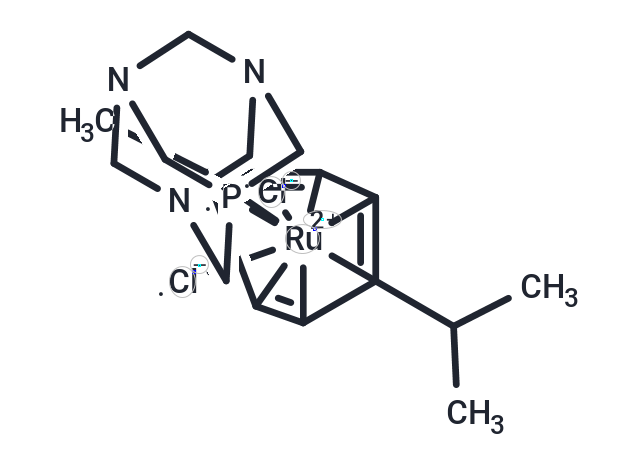
RAPTA-C
CAS No. 372948-28-2
RAPTA-C( —— )
Catalog No. M34689 CAS No. 372948-28-2
RAPTA-C induces EAC cell cycle arrest and apoptosis via the mitochondrial and p53-JNK pathways, and can be used in the study of breast and ovarian cancer.
Purity : >98% (HPLC)
 COA
Datasheet
HNMR
HPLC
MSDS
Handing Instructions
COA
Datasheet
HNMR
HPLC
MSDS
Handing Instructions
| Size | Price / USD | Stock | Quantity |
| 5MG | 160 | In Stock |


|
| 10MG | 236 | In Stock |
|
| 25MG | 404 | In Stock |
|
| 50MG | 574 | In Stock |
|
| 100MG | Get Quote | In Stock |
|
| 200MG | Get Quote | In Stock |
|
| 500MG | Get Quote | In Stock |
|
| 1G | Get Quote | In Stock |
|
Biological Information
-
Product NameRAPTA-C
-
NoteResearch use only, not for human use.
-
Brief DescriptionRAPTA-C induces EAC cell cycle arrest and apoptosis via the mitochondrial and p53-JNK pathways, and can be used in the study of breast and ovarian cancer.
-
DescriptionRAPTA-C induces EAC cell cycle arrest and apoptosis via the mitochondrial and p53-JNK pathways, and can be used in the study of breast and ovarian cancer.
-
In Vitro——
-
In Vivo——
-
Synonyms——
-
PathwayApoptosis
-
TargetApoptosis
-
RecptorApoptosis
-
Research Area——
-
Indication——
Chemical Information
-
CAS Number372948-28-2
-
Formula Weight463.35
-
Molecular FormulaC16H26Cl2N3PRu
-
Purity>98% (HPLC)
-
Solubility——
-
SMILES[Cl-][Ru+2]12345([Cl-])([CH]=6[CH]5=C4(C(C)C)[CH]3=[CH]2C61C)[P]78CN9CN(CN(C9)C7)C8
-
Chemical Name——
Shipping & Storage Information
-
Storage(-20℃)
-
ShippingWith Ice Pack
-
Stability≥ 2 years
Reference
molnova catalog



related products
-
CNX-774
CNX-774 is a highly specific, irreversible, and orally active BTK inhibitor (IC50<1 nM).
-
TVB-3166
TVB-3166 induces apoptosis and inhibits in-vivo xenograft tumor growth. TVB-3166 is a reversible and selective fatty acid synthase inhibitor (IC50s: 42 nM and 81 nM for biochemical FASN and cellular palmitate synthesis, respectively).
-
9-cis-Retinoic Acid
9-cis-Retinoic Acid (Alitretinoin) is a derivative of vitamin A. It is a RAR/RXR agonist with anticancer, antitumor, anti-inflammatory, and neuroprotective activities, induces apoptosis, regulates the cell cycle, and can be used to study advanced tumors.
