


 Cart
Cart
 sales@molnova.com



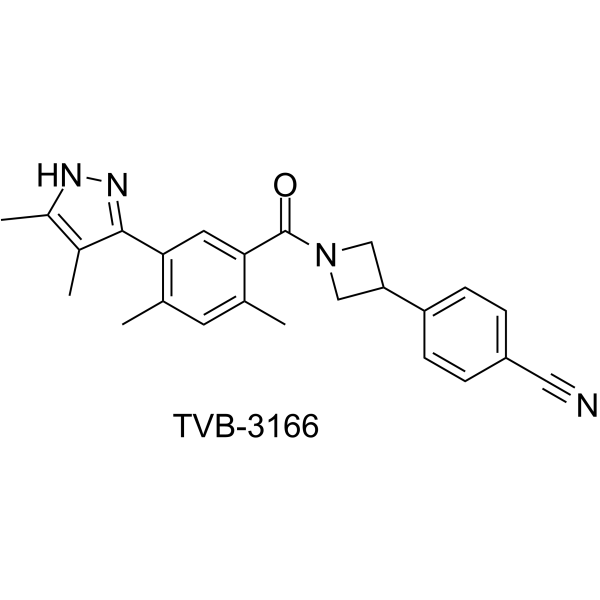
TVB-3166
CAS No. 1533438-83-3
TVB-3166( —— )
Catalog No. M26854 CAS No. 1533438-83-3
TVB-3166 induces apoptosis and inhibits in-vivo xenograft tumor growth. TVB-3166 is a reversible and selective fatty acid synthase inhibitor (IC50s: 42 nM and 81 nM for biochemical FASN and cellular palmitate synthesis, respectively).
Purity : >98% (HPLC)
 COA
Datasheet
HNMR
HPLC
MSDS
Handing Instructions
COA
Datasheet
HNMR
HPLC
MSDS
Handing Instructions
| Size | Price / USD | Stock | Quantity |
| 1 mL x 10 mM in DMSO | 85 | In Stock |


|
| 2MG | 46 | In Stock |
|
| 5MG | 76 | In Stock |
|
| 10MG | 112 | In Stock |
|
| 25MG | 206 | In Stock |
|
| 50MG | 346 | In Stock |
|
| 100MG | 517 | In Stock |
|
| 200MG | Get Quote | In Stock |
|
| 500MG | Get Quote | In Stock |
|
| 1G | Get Quote | In Stock |
|
Biological Information
-
Product NameTVB-3166
-
NoteResearch use only, not for human use.
-
Brief DescriptionTVB-3166 induces apoptosis and inhibits in-vivo xenograft tumor growth. TVB-3166 is a reversible and selective fatty acid synthase inhibitor (IC50s: 42 nM and 81 nM for biochemical FASN and cellular palmitate synthesis, respectively).
-
DescriptionTVB-3166 induces apoptosis and inhibits in-vivo xenograft tumor growth. TVB-3166 is a reversible and selective fatty acid synthase inhibitor (IC50s: 42 nM and 81 nM for biochemical FASN and cellular palmitate synthesis, respectively).(In Vitro):TVB-3166 (0.2 μM; 48 hours) inhibits β-catenin pathway signal transduction and transcriptional activity. TVB-3166 (0.02 or 0.20 μM; 7 days) suppresses palmitate synthesis and tumor cell viability in a dose-dependent manner. TVB-3166 (0.001-10 μM; 24 hours) induces cell death in CALU-6 non-small-cell lung tumor cells (cellular IC50: 0.10 μM) . (In Vivo):TVB-3166 (Oral gavage; 30-100 mg/kg/day) has the concentration is approximately 3-fold higher in plasma than the tumor. TVB-3166 (Oral gavage; 30-100 mg/kg/day) inhibits xenograft tumor growth. The 100 and 30 mg/kg groups had plasma and tumor concentrations of 7 and 2.9 μM, respectively .
-
In VitroCell Proliferation Assay Cell Line:CALU-6 tumor cells Concentration:0.001, 0.01, 0.1, 1, 10 μMIncubation Time:24 hoursResult:Caused cell death in CALU-6 non-small-cell lung tumor cells with a cellular IC50 value of 0.10 μM.Cell Viability Assay Cell Line:90 different tumor cell lines (such as CALU-6 NSCLC cell line, NCI-H1975 NSCLC cell line) Concentration:0.02 or 0.20 μM Incubation Time:7 days Result:Dose-dependent induction of cell death was observed in all tumor cell lines.Western Blot Analysis Cell Line:COLO-205 and A549 cells Concentration:0.2 μM Incubation Time:48 hours Result:Inhibited β-catenin pathway signal transduction and transcriptional activity.
-
In VivoAnimal Model:Female BALB-c-nude miceDosage:30, 60, or 100 mg/kg Administration:Oral gavage; once daily Result:Inhibited xenograft tumor growth.Animal Model:Female BALB-c-nude miceDosage:30, 60, or 100 mg/kg (Pharmacokinetic Study)Administration:Oral gavage; once daily Result:The concentration was approximately 3-fold higher in plasma than tumor. The 100 and 30 mg/kg groups had plasma and tumor concentrations of 7 and 2.9 μM, respectively.
-
Synonyms——
-
PathwayApoptosis
-
TargetApoptosis
-
RecptorBacterial
-
Research Area——
-
Indication——
Chemical Information
-
CAS Number1533438-83-3
-
Formula Weight384.483
-
Molecular FormulaC24H24N4O
-
Purity>98% (HPLC)
-
SolubilityIn Vitro:?DMSO : 62.5 mg/mL (162.56 mM)
-
SMILESCc1n[nH]c(c1C)-c1cc(C(=O)N2CC(C2)c2ccc(cc2)C#N)c(C)cc1C
-
Chemical Name——
Shipping & Storage Information
-
Storage(-20℃)
-
ShippingWith Ice Pack
-
Stability≥ 2 years
Reference
1.Kunimoto S, et al. Reversal of resistance by N-acetyltyramine or N-acetyl-2-phenylethylamine in doxorubicin-resistant leukemia P388 cells. J Antibiot (Tokyo). 1987;40(11):1651-1652.
molnova catalog



related products
-
UCF 101
UCF 101 is a specific inhibitor of HtrA2 and reduces apoptosis in PC12 cells.
-
(-)-Anonaine
(-)-Anonaine can be extracted from several species of Magnoliaceae and Annelidae and has antimalarial, antibacterial, antifungal, antioxidant, anticancer, antidepressant and vasodilatory activities.
-
Polygalacin D
Polygalacin D shows anti- proliferation, anti-inflammary, and hepatoprotective activities.
