


 Cart
Cart
 sales@molnova.com



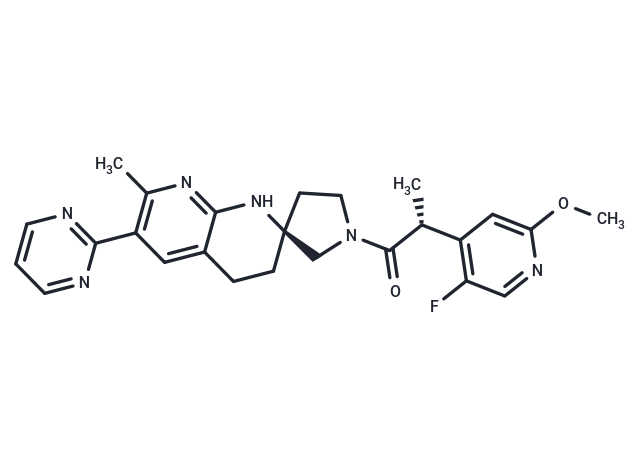
PF-07258669
CAS No. 2755890-53-8
PF-07258669( —— )
Catalog No. M36282 CAS No. 2755890-53-8
PF-07258669 is a selective melanocortin 4 receptor (MC4) antagonist used in the study of cachexia and loss of appetite.
Purity : >98% (HPLC)
 COA
Datasheet
HNMR
HPLC
MSDS
Handing Instructions
COA
Datasheet
HNMR
HPLC
MSDS
Handing Instructions
| Size | Price / USD | Stock | Quantity |
| 5MG | 1606 | In Stock |


|
| 10MG | 2613 | In Stock |
|
| 25MG | 5159 | In Stock |
|
| 50MG | 8082 | In Stock |
|
| 100MG | Get Quote | In Stock |
|
| 200MG | Get Quote | In Stock |
|
| 500MG | Get Quote | In Stock |
|
| 1G | Get Quote | In Stock |
|
Biological Information
-
Product NamePF-07258669
-
NoteResearch use only, not for human use.
-
Brief DescriptionPF-07258669 is a selective melanocortin 4 receptor (MC4) antagonist used in the study of cachexia and loss of appetite.
-
DescriptionPF-07258669 is a melanocortin-4 receptor (MC4) antagonist. PF-07258669 can be used for the research of cachexia, anorexia, or anorexia nervosa.
-
In Vitro——
-
In Vivo——
-
Synonyms——
-
PathwayGPCR/G Protein
-
TargetMelanocortin Receptor
-
RecptorMelanocortin Receptor
-
Research Area——
-
Indication——
Chemical Information
-
CAS Number2755890-53-8
-
Formula Weight462.52
-
Molecular FormulaC25H27FN6O2
-
Purity>98% (HPLC)
-
Solubility——
-
SMILESC([C@H](C)C=1C=C(OC)N=CC1F)(=O)N2C[C@@]3(NC=4C(CC3)=CC(=C(C)N4)C=5N=CC=CN5)CC2
-
Chemical Name——
Shipping & Storage Information
-
Storage(-20℃)
-
ShippingWith Ice Pack
-
Stability≥ 2 years
Reference
1. Christopher Ryan BUTLER, et al. Spiro compounds as melanocortin 4 receptor antagonists and uses thereof. Patent. WO2021250541A1.
molnova catalog



related products
-
PG 106
Selective hMC3 receptor antagonist (IC50 = 210 nM). Exhibits no activity at hMC4 receptors and hMC5 receptors.
-
PF-00446687 hydrochl...
PF-00446687 hydrochloride (PF-446687) is a potent, selective melanocortin-4 receptor (MC4R) agonist with EC50 of 12 nM.
-
Neuropeptide EI, rat
Displays functional MCH-antagonist and MSH-agonist activity in different behavioral paradigms.
