


 Cart
Cart
 sales@molnova.com



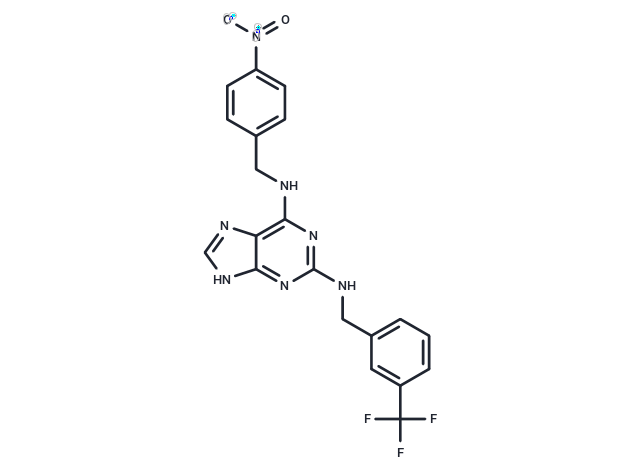
TNP
CAS No. 519178-28-0
TNP( —— )
Catalog No. M35284 CAS No. 519178-28-0
TNP (IP3K Inhibitor) is a cell-permeable inhibitor of IP6K1 and IP3K, with IC 50 values of 0.55 μM and 10.2 μM for IP6K1 and IP3K, respectively.
Purity : >98% (HPLC)
 COA
Datasheet
HNMR
HPLC
MSDS
Handing Instructions
COA
Datasheet
HNMR
HPLC
MSDS
Handing Instructions
| Size | Price / USD | Stock | Quantity |
| 1 mL x 10 mM in DMSO | 55 | In Stock |


|
| 2MG | 33 | In Stock |
|
| 5MG | 55 | In Stock |
|
| 10MG | 79 | In Stock |
|
| 25MG | 179 | In Stock |
|
| 50MG | 314 | In Stock |
|
| 100MG | Get Quote | In Stock |
|
| 200MG | Get Quote | In Stock |
|
| 500MG | Get Quote | In Stock |
|
| 1G | Get Quote | In Stock |
|
Biological Information
-
Product NameTNP
-
NoteResearch use only, not for human use.
-
Brief DescriptionTNP (IP3K Inhibitor) is a cell-permeable inhibitor of IP6K1 and IP3K, with IC 50 values of 0.55 μM and 10.2 μM for IP6K1 and IP3K, respectively.
-
DescriptionTNP is a cell-permeable inhibitor of IP6K1 and IP3K, with IC50 values of 0.55 μM and 10.2 μM for IP3K, respectively. TNP binds to the ATP-binding sites of both enzymes.
-
In Vitro——
-
In Vivo——
-
Synonyms——
-
PathwayOthers
-
TargetOther Targets
-
RecptorOthers
-
Research Area——
-
Indication——
Chemical Information
-
CAS Number519178-28-0
-
Formula Weight443.38
-
Molecular FormulaC20H16F3N7O2
-
Purity>98% (HPLC)
-
SolubilityIn Vitro:?DMSO : 37.5 mg/mL (84.58 mM; Ultrasonic )
-
SMILES[O-][N+](=O)c1ccc(CNc2nc(NCc3cccc(c3)C(F)(F)F)nc3[nH]cnc23)cc1
-
Chemical Name——
Shipping & Storage Information
-
Storage(-20℃)
-
ShippingWith Ice Pack
-
Stability≥ 2 years
Reference
1. Chang YT, et al. Purine-based inhibitors of inositol-1,4,5-trisphosphate-3-kinase. Chembiochem. 2002 Sep 2;3(9):897-901.?
molnova catalog



related products
-
LGE-899
LGE-899 is a main metabolite of Sonidegib which is an inhibitor of the hedgehog pathway.
-
Penetratin-Arg
Penetratin-Arg
-
Forchlorfenuron (KT-...
Forchlorfenuron is plant growth regulator and cytokinin; can be used to increase fruit size of fruits.
