


 Cart
Cart
 sales@molnova.com



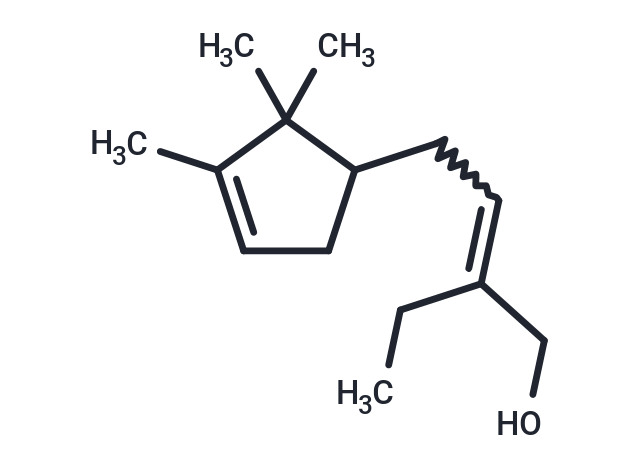
Sandacanol
CAS No. 28219-61-6
Sandacanol( —— )
Catalog No. M34892 CAS No. 28219-61-6
Sandacanol(Sandranol) is a selective olfactory receptor (OR10H1) agonist. Sandacanol can induce cell cycle arrest and partial apoptosis in bladder cancer cells, and can reduce cell migration rate and proliferation rate.
Purity : >98% (HPLC)
 COA
Datasheet
HNMR
HPLC
MSDS
Handing Instructions
COA
Datasheet
HNMR
HPLC
MSDS
Handing Instructions
| Size | Price / USD | Stock | Quantity |
| 1 mL x 10 mM in DMSO | 28 | In Stock |


|
| 100MG | 27 | In Stock |
|
| 200MG | Get Quote | In Stock |
|
| 500MG | Get Quote | In Stock |
|
| 1G | Get Quote | In Stock |
|
Biological Information
-
Product NameSandacanol
-
NoteResearch use only, not for human use.
-
Brief DescriptionSandacanol(Sandranol) is a selective olfactory receptor (OR10H1) agonist. Sandacanol can induce cell cycle arrest and partial apoptosis in bladder cancer cells, and can reduce cell migration rate and proliferation rate.
-
DescriptionSandacanol is a specific agonist of olfactory receptor (OR10H1). Sandacanol induces cell cycle arrest and some apoptosis in bladder cancer cells.
-
In VitroSandacanol (50, 100, 300, 500, and 700 μM; 24 or 48 h) treatment significantly diminishes cell viability, cell proliferation and migration and induces a limited degree of apoptosis in BFTC905 bladder cancer cells.
-
In Vivo——
-
Synonyms——
-
PathwayApoptosis
-
TargetApoptosis
-
RecptorApoptosis
-
Research Area——
-
Indication——
Chemical Information
-
CAS Number28219-61-6
-
Formula Weight208.34
-
Molecular FormulaC14H24O
-
Purity>98% (HPLC)
-
Solubility——
-
SMILESOCC(=CCC1CC=C(C)C1(C)C)CC
-
Chemical Name——
Shipping & Storage Information
-
Storage(-20℃)
-
ShippingWith Ice Pack
-
Stability≥ 2 years
Reference
1. Lea Weber, et al. Characterization of the Olfactory Receptor OR10H1 in Human Urinary Bladder Cancer. Front Physiol. 2018 May 16;9:456.?
molnova catalog



related products
-
Manganese chloride
Manganese chloride inhibits proliferation in a dose- and time-dependent manner induces G0/G1 and S phase arrest and apoptosis in A549 cells.
-
MitoBloCK-6
MitoBloCK-6 is a potent Erv1/ALR inhibitor with IC50 values of 900 nM and 700 nM, respectively, and also inhibits Erv2 with an IC50 of 1.4 μM.
-
Inecalcitol
Inecalcitol is the growth inhibitor of human breast cancer cells. Inecalcitol is a unique vitamin D3 analog with Kd of 0.53 nM.
