


 Cart
Cart
 sales@molnova.com



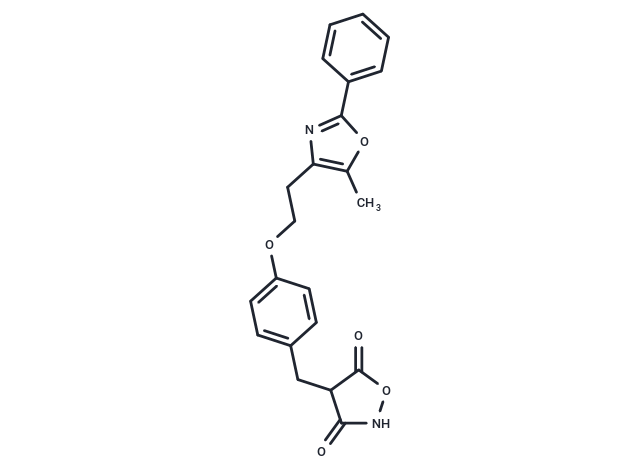
Reglitazar
CAS No. 170861-63-9
Reglitazar( —— )
Catalog No. M34392 CAS No. 170861-63-9
Reglitazar (JTT-501) is a dual PPARα and PPARγ agonist that is used to study diabetes.
Purity : >98% (HPLC)
 COA
Datasheet
HNMR
HPLC
MSDS
Handing Instructions
COA
Datasheet
HNMR
HPLC
MSDS
Handing Instructions
| Size | Price / USD | Stock | Quantity |
| 5MG | 686 | In Stock |


|
| 10MG | 938 | In Stock |
|
| 25MG | 1444 | In Stock |
|
| 50MG | 1841 | In Stock |
|
| 100MG | Get Quote | In Stock |
|
| 200MG | Get Quote | In Stock |
|
| 500MG | Get Quote | In Stock |
|
| 1G | Get Quote | In Stock |
|
Biological Information
-
Product NameReglitazar
-
NoteResearch use only, not for human use.
-
Brief DescriptionReglitazar (JTT-501) is a dual PPARα and PPARγ agonist that is used to study diabetes.
-
DescriptionReglitazar (JTT-501) is a dual PPARα and PPARγ agonist that is used to study diabetes.
-
In Vitro——
-
In Vivo——
-
Synonyms——
-
PathwayMetabolic Enzyme/Protease
-
TargetPPAR
-
RecptorPPAR
-
Research Area——
-
Indication——
Chemical Information
-
CAS Number170861-63-9
-
Formula Weight392.4
-
Molecular FormulaC22H20N2O5
-
Purity>98% (HPLC)
-
Solubility——
-
SMILESO=C1ONC(=O)C1CC2=CC=C(OCCC=3N=C(OC3C)C=4C=CC=CC4)C=C2
-
Chemical Name——
Shipping & Storage Information
-
Storage(-20℃)
-
ShippingWith Ice Pack
-
Stability≥ 2 years
Reference
molnova catalog



related products
-
CGS 15435
CGS 15435 is a potent thromboxen (TxA2) synthetase inhibitor (IC50: 1 nM). CGS 15435 acts on PGI2 synthase, cyclooxygenase and liposynthase with much less selectivity than on thromboxin synthase.
-
MCC 555
MCC 555 (Isaglitazone;Netoglitazone;RWJ 241947) is an activating ligand of PPARγ with EC50 of 8 uM.
-
GW1929
GW1929 is a potent PPAR-γ agonist (pKi: 8.84 for human PPAR-γ; pEC50s of 8.56 and 8.27 for human and murine PPAR-γ).
