


 Cart
Cart
 sales@molnova.com



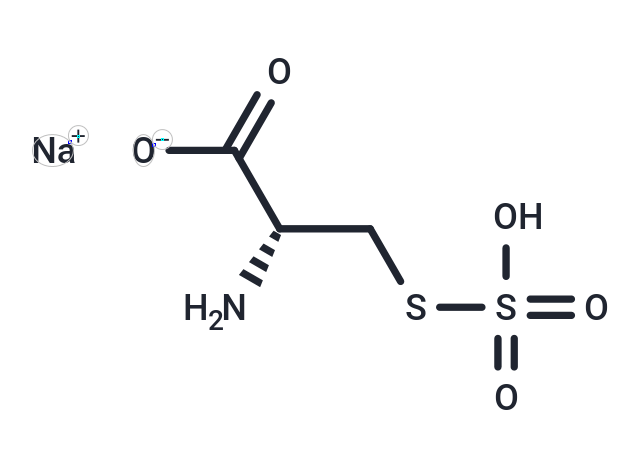
S-Sulfo-L-cysteine sodium salt
CAS No. 7381-67-1
S-Sulfo-L-cysteine sodium salt( —— )
Catalog No. M33921 CAS No. 7381-67-1
S-Sulfo-L-cysteine sodium salt shows a weak affinity for mGluR1α and mGluR5a at high concentrations and has potential antioxidant activity.
Purity : >98% (HPLC)
 COA
Datasheet
HNMR
HPLC
MSDS
Handing Instructions
COA
Datasheet
HNMR
HPLC
MSDS
Handing Instructions
| Size | Price / USD | Stock | Quantity |
| 5MG | 151 | In Stock |


|
| 10MG | 223 | In Stock |
|
| 25MG | 373 | In Stock |
|
| 50MG | 521 | In Stock |
|
| 100MG | 709 | In Stock |
|
| 200MG | 918 | In Stock |
|
| 500MG | Get Quote | In Stock |
|
| 1G | Get Quote | In Stock |
|
Biological Information
-
Product NameS-Sulfo-L-cysteine sodium salt
-
NoteResearch use only, not for human use.
-
Brief DescriptionS-Sulfo-L-cysteine sodium salt shows a weak affinity for mGluR1α and mGluR5a at high concentrations and has potential antioxidant activity.
-
DescriptionL-Cysteine S-sulfate sodium is a potent N-methyl-d-aspartate (NMDA) glutamatergic receptors agonist. L-Cysteine S-sulfate sodium hydrate is the substrate for cystine lyase, it can be used in mass spectrometry operations.
-
In Vitro——
-
In Vivo——
-
Synonyms——
-
PathwayNeuroscience
-
TargetGluR
-
RecptorGluR | Antioxidant
-
Research Area——
-
Indication——
Chemical Information
-
CAS Number7381-67-1
-
Formula Weight223.2
-
Molecular FormulaC3H6NNaO5S2
-
Purity>98% (HPLC)
-
Solubility——
-
SMILES[O-]C([C@@H](N)CSS(=O)(O)=O)=O.[Na+]
-
Chemical Name——
Shipping & Storage Information
-
Storage(-20℃)
-
ShippingWith Ice Pack
-
Stability≥ 2 years
Reference
1. Steventon GB, et, al. Comparison of the sulfur-oxygenation of cysteine and S-carboxymethyl-l-cysteine in human hepatic cytosol and the r?le of cysteine dioxygenase. J Pharm Pharmacol. 2018 Aug;70(8):1069-1077.?
molnova catalog



related products
-
Sibiricose A6
Sibiricose A6 displays antidepressant-like action, it may prevent or relieve depression.
-
Irbinitinib
Irbinitinib(ARRY-380; ONT-380) is a potent and selective HER2 inhibitor (IC50: 8 nM).
-
Cutamesine dihydroch...
Cutamesine dihydrochloride is a selective?σ1 receptor agonist (IC50: 17.4 nM).
