


 Cart
Cart
 sales@molnova.com



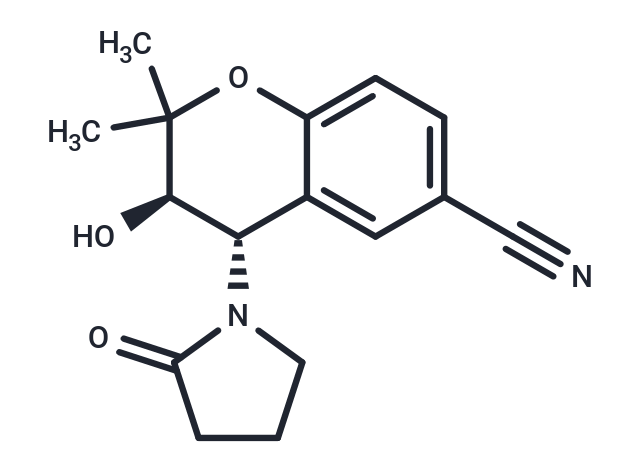
Cromakalim
CAS No. 94470-67-4
Cromakalim( —— )
Catalog No. M33734 CAS No. 94470-67-4
Cromakalim (BRL 34915) is an ATP-dependent K(+) channel opener and a smooth muscle relaxant.
Purity : >98% (HPLC)
 COA
Datasheet
HNMR
HPLC
MSDS
Handing Instructions
COA
Datasheet
HNMR
HPLC
MSDS
Handing Instructions
| Size | Price / USD | Stock | Quantity |
| 2MG | 44 | In Stock |


|
| 100MG | Get Quote | In Stock |
|
| 200MG | Get Quote | In Stock |
|
| 500MG | Get Quote | In Stock |
|
| 1G | Get Quote | In Stock |
|
Biological Information
-
Product NameCromakalim
-
NoteResearch use only, not for human use.
-
Brief DescriptionCromakalim (BRL 34915) is an ATP-dependent K(+) channel opener and a smooth muscle relaxant.
-
DescriptionCromakalim is a potassium channel opener. Cromakalim can be used as a bronchodilator in asthma. Cromakalim inhibits the spontaneous tone of human isolated bronchi in a concentration-related manner being nearly as effective as isoprenaline or theophylline.
-
In Vitro——
-
In Vivo——
-
Synonyms——
-
PathwayCell Cycle/DNA Damage
-
TargetPotassium Channel
-
RecptorPotassium Channel
-
Research Area——
-
Indication——
Chemical Information
-
CAS Number94470-67-4
-
Formula Weight286.33
-
Molecular FormulaC16H18N2O3
-
Purity>98% (HPLC)
-
SolubilityIn Vitro:?DMSO : 66.67 mg/mL (232.84 mM; Ultrasonic )
-
SMILESCC1(C)Oc2ccc(cc2[C@@H]([C@H]1O)N1CCCC1=O)C#N
-
Chemical Name——
Shipping & Storage Information
-
Storage(-20℃)
-
ShippingWith Ice Pack
-
Stability≥ 2 years
Reference
1. Cortijo J, et al. The relaxant effects of cromakalim (BRL 34915) on human isolated airway smooth muscle. Naunyn Schmiedebergs Arch Pharmacol. 1992;346(4):462-468.?
molnova catalog



related products
-
Rimtuzalcap
Rimtuzalcap (CAD-1883) is a first-in-class selective positive allosteric modulator of small-conductance calcium-activated potassium channels (SK channels).
-
ML418
ML418 is a potent, selective and CNS penetrating Kir7.1 potassium channel blocker (IC50 = 310 nM), and also potently inhibits Kir6.2/SUR1.
-
Methyl gypsogenin 3-...
Gypsogenin 3-O-beta-D-glucuronopyranoside shows inhibitory activity toward pancreatic lipase with IC5 value of .29 mM.
