


 Cart
Cart
 sales@molnova.com



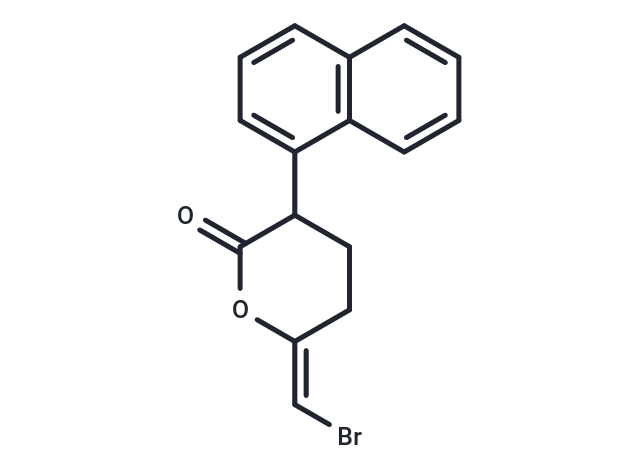
Bromoenol lactone
CAS No. 88070-98-8
Bromoenol lactone( —— )
Catalog No. M33297 CAS No. 88070-98-8
Bromoenol lactone ((6E)-Bromoenol lactone) is a selective calcium-dependent phospholipase A2 (iPLA2β) and serine protease inhibitor that attenuates nicotine-induced breast cancer cell proliferation and migrations.
Purity : >98% (HPLC)
 COA
Datasheet
HNMR
HPLC
MSDS
Handing Instructions
COA
Datasheet
HNMR
HPLC
MSDS
Handing Instructions
| Size | Price / USD | Stock | Quantity |
| 1 mL x 10 mM in DMSO | 154 | In Stock |


|
| 2MG | 61 | In Stock |
|
| 5MG | 89 | In Stock |
|
| 10MG | 140 | In Stock |
|
| 100MG | Get Quote | In Stock |
|
| 200MG | Get Quote | In Stock |
|
| 500MG | Get Quote | In Stock |
|
| 1G | Get Quote | In Stock |
|
Biological Information
-
Product NameBromoenol lactone
-
NoteResearch use only, not for human use.
-
Brief DescriptionBromoenol lactone ((6E)-Bromoenol lactone) is a selective calcium-dependent phospholipase A2 (iPLA2β) and serine protease inhibitor that attenuates nicotine-induced breast cancer cell proliferation and migrations.
-
DescriptionBromoenol lactone ((6E)-Bromoenol lactone) is a suicide-based irreversible, selective, potent inhibitor of calcium-independent phospholipase A2 (iPLA2β) with an IC50 value of approximately 7 μM, which inhibits antigen-stimulated mast cell exocytosis without blocking Ca2+ influx.
-
In VitroIn RBL 2H3 and bone marrow-derived mast cells (BMMCs), Ca2+ entry is critical for exocytosis. Bromoenol lactone inhibits exocytosis when stimulated using a Ca2+ ionophore A23187, which passively transports Ca2+ down a concentration gradient and also in permeabilised mast cells where Ca2+ entry is no longer relevant. Moreover, Bromoenol lactone has only a minor effect on antigen- or thapsigargin-stimulated Ca2+ signalling, both the release from internal stores and sustained elevation due to Ca2+ influx.
-
In Vivo——
-
Synonyms——
-
PathwayMetabolic Enzyme/Protease
-
TargetPhospholipase
-
RecptorPhospholipase
-
Research Area——
-
Indication——
Chemical Information
-
CAS Number88070-98-8
-
Formula Weight317.18
-
Molecular FormulaC16H13BrO2
-
Purity>98% (HPLC)
-
SolubilityIn Vitro:?DMSO : 50 mg/mL (157.64 mM; Ultrasonic )
-
SMILESO=C1C(C=2C3=C(C=CC2)C=CC=C3)CC/C(=C\Br)/O1
-
Chemical Name——
Shipping & Storage Information
-
Storage(-20℃)
-
ShippingWith Ice Pack
-
Stability≥ 2 years
Reference
1. Fensome-Green A, et al. Bromoenol lactone, an inhibitor of Group V1A calcium-independent phospholipase A2 inhibits antigen-stimulated mast cell exocytosis without blocking Ca2+ influx. Cell Calcium. 2007 Feb;41(2):145-53.?
molnova catalog



related products
-
ML-299
ML-299 is a dual PLD1/2 inhibitor (PLD1 and PLD2, IC50 of 6 nM, 20 nM, respectively).
-
U 73343
U 73343 is an inactive analog of U 73122 and can be used as a negative control. It dose-dependently inhibits acid secretion irrespective of the stimulant.
-
Melittin TFA(20449-7...
Melittin TFA is a small protein containing 26 amino acid residues, is the principal toxic component of bee venom. Melittin is a PLA2 activator, stimulates the activity of the low molecular weight PLA2, while it does not the increase activity of the high molecular weight PLA2.Melittin, an immunologically related PLA2 stimulating peptide from bee venom, increases the activity of the high molecular weight enzyme.
