


 Cart
Cart
 sales@molnova.com



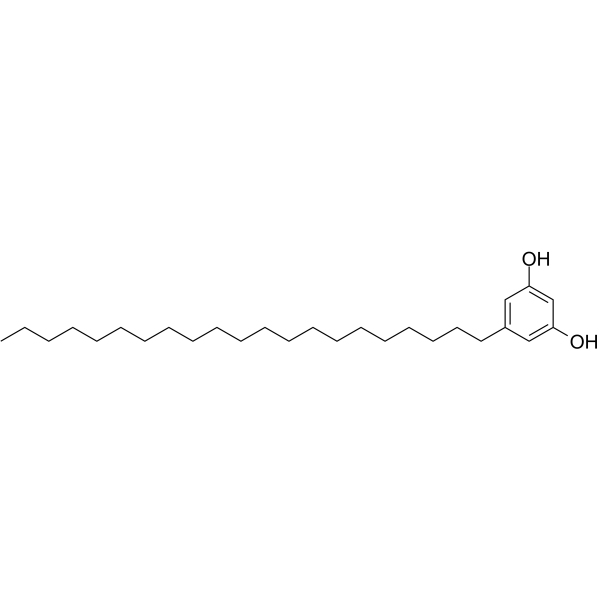
5-Heneicosylresorcinol
CAS No. 70110-59-7
5-Heneicosylresorcinol( —— )
Catalog No. M29269 CAS No. 70110-59-7
5-Heneicosylresorcinol shows inhibitory effects on the release of β-hexosaminidase from RBL-2H3 cells, it also prevents triglyceride accumulation in 3T3-L1 cells. 5-Heneicosylresorcinol has nematicidal activity against nematodes Panagrellus redivivus, Caenothabditis elegans and Bursaphelenchus xylophilus, with ED50 values of 80, 30, and 180 ug/mL, respectively.
Purity : >98% (HPLC)
 COA
Datasheet
HNMR
HPLC
MSDS
Handing Instructions
COA
Datasheet
HNMR
HPLC
MSDS
Handing Instructions
| Size | Price / USD | Stock | Quantity |
| 5MG | 258 | In Stock |


|
| 10MG | 385 | In Stock |
|
| 25MG | 695 | In Stock |
|
| 50MG | 1032 | In Stock |
|
| 100MG | 1563 | In Stock |
|
| 200MG | Get Quote | In Stock |
|
| 500MG | Get Quote | In Stock |
|
| 1G | Get Quote | In Stock |
|
Biological Information
-
Product Name5-Heneicosylresorcinol
-
NoteResearch use only, not for human use.
-
Brief Description5-Heneicosylresorcinol shows inhibitory effects on the release of β-hexosaminidase from RBL-2H3 cells, it also prevents triglyceride accumulation in 3T3-L1 cells. 5-Heneicosylresorcinol has nematicidal activity against nematodes Panagrellus redivivus, Caenothabditis elegans and Bursaphelenchus xylophilus, with ED50 values of 80, 30, and 180 ug/mL, respectively.
-
Description5-Heneicosylresorcinol shows inhibitory effects on the release of β-hexosaminidase from RBL-2H3 cells, it also prevents triglyceride accumulation in 3T3-L1 cells. 5-Heneicosylresorcinol has nematicidal activity against nematodes Panagrellus redivivus, Caenothabditis elegans and Bursaphelenchus xylophilus, with ED50 values of 80, 30, and 180 ug/mL, respectively.(In Vitro):Alkylresorcinols are phenolic lipids present at levels of 0.03-0.15% in wheat and rye grains and almost 10 times higher in respective bran products. Despite numerous studies on the influence of dietary fibers on the regulation of energy metabolism, this issue still remains controversial. METHODS AND RESULTS: The objective of our current studies was to investigate whether 5-n-alk(en)ylresorcinols, natural phenolic components of high fiber human diets, may be considered as natural regulators of excessive fat accumulation. Our studies revealed that 5-n-alk(en)ylresorcinols isolated from wheat and rye bran inhibit glycerol-3-phosphate dehydrogenase, the key enzyme in triglyceride synthesis in adipocytes, specifically and effectively. Further in vitro studies showed that these compounds also prevent triglyceride accumulation in 3T3-L1 cells. CONCLUSIONS: The most effective compound in both systems was 5-n-heneicosylresorcinol(5-Heneicosylresorcinol). The results indicate that the potential to prevent triglyceride accumulation increases with the hydrophobicity of the phenolic inhibitor.
-
In Vitro——
-
In Vivo——
-
Synonyms——
-
PathwayMembrane Transporter/Ion Channel
-
TargetNADPH
-
RecptorNADPH
-
Research Area——
-
Indication——
Chemical Information
-
CAS Number70110-59-7
-
Formula Weight404.66
-
Molecular FormulaC27H48O2
-
Purity>98% (HPLC)
-
Solubility——
-
SMILESCCCCCCCCCCCCCCCCCCCCCc1cc(O)cc(O)c1
-
Chemical Name——
Shipping & Storage Information
-
Storage(-20℃)
-
ShippingWith Ice Pack
-
Stability≥ 2 years
Reference
molnova catalog



related products
-
AKR1C3-IN-1
AKR1C3-IN-1 is a potent and selective inhibitor of AKR1C3(IC50 of 13 nM).
-
APX-115 freebase
APX-115 (Ewha 18278)?is a first-in-class, orally active, pan-NADPH oxidase (Nox) inhibitor with Ki of 1.08, 0.57, 0.63 nM for Nox1, Nox2, and Nox4, respectively.
-
Phloretic acid
Phloretic acid is a phenolic compound. It can be used to produce polyesters based on phloretic acid and gallic acid.
