


 Cart
Cart
 sales@molnova.com



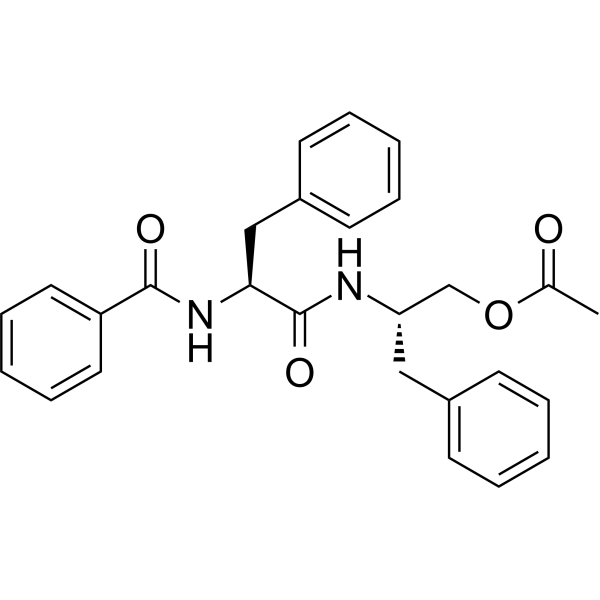
Aurantiamide acetate
CAS No. 56121-42-7
Aurantiamide acetate( Asperglaucide )
Catalog No. M29027 CAS No. 56121-42-7
Aurantiamide acetate was isolated from the fermentation broth of Aspergillus penicilloides for the first time. Aurantiamide acetate is a selective and orally active cathepsin inhibitor. Aurantiamide acetate has anti-inflammatory activities and can be used for the study of inflammatory diseases.
Purity : >98% (HPLC)
 COA
Datasheet
HNMR
HPLC
MSDS
Handing Instructions
COA
Datasheet
HNMR
HPLC
MSDS
Handing Instructions
| Size | Price / USD | Stock | Quantity |
| 1 mL x 10 mM in DMSO | 240 | In Stock |


|
| 5MG | 211 | In Stock |
|
| 10MG | 312 | In Stock |
|
| 25MG | 524 | In Stock |
|
| 100MG | Get Quote | In Stock |
|
| 200MG | Get Quote | In Stock |
|
| 500MG | Get Quote | In Stock |
|
| 1G | Get Quote | In Stock |
|
Biological Information
-
Product NameAurantiamide acetate
-
NoteResearch use only, not for human use.
-
Brief DescriptionAurantiamide acetate was isolated from the fermentation broth of Aspergillus penicilloides for the first time. Aurantiamide acetate is a selective and orally active cathepsin inhibitor. Aurantiamide acetate has anti-inflammatory activities and can be used for the study of inflammatory diseases.
-
DescriptionAurantiamide acetate was isolated from the fermentation broth of Aspergillus penicilloides for the first time. Aurantiamide acetate is a selective and orally active cathepsin inhibitor. Aurantiamide acetate has anti-inflammatory activities and can be used for the study of inflammatory diseases.(In Vitro):Aurantiamide acetate decreases viability of U87 and U251 cancer cells in vitro when used at concentrations ranging from 10 to 100 μM. Aurantiamide acetate inhibited cysteine proteinases, in particular, cathepsin L and B with IC50 of 12 microM and 49 microM, respectively. (In Vivo):Aurantiamide acetate reduces tumor growth when administered at a dose of 1 mg via intratumoral injection in a U87 mouse xenograft model. In the adjuvant-arthritic rat model, subcutaneously administered 10 mg/kg body weight of this compound suppressed hind paw swelling.
-
In VitroAurantiamide acetate inhibits cathepsin L (3.4.22.15) and cathepsin B (3.4.22.1) with IC50?of 12 μM and 49 μM, respectiveiy.
-
In Vivo——
-
SynonymsAsperglaucide
-
PathwayProteasome/Ubiquitin
-
TargetCysteine Protease
-
RecptorCysteine Protease
-
Research Area——
-
Indication——
Chemical Information
-
CAS Number56121-42-7
-
Formula Weight444.52
-
Molecular FormulaC27H28N2O4
-
Purity>98% (HPLC)
-
SolubilityIn Vitro:?DMSO : 50 mg/mL (112.48 mM)
-
SMILESCC(OC[C@H](Cc1ccccc1)NC([C@H](Cc1ccccc1)NC(c1ccccc1)=O)=O)=O
-
Chemical Name——
Shipping & Storage Information
-
Storage(-20℃)
-
ShippingWith Ice Pack
-
Stability≥ 2 years
Reference
molnova catalog



related products
-
PMSF
PMSF (Phenylmethanesulfonyl fluoride) is an irreversible inhibitor of serine proteinases.
-
JTE-607 HCl
JTE-607 is a cytokine production inhibitor. JTE-607 induces apoptosis accompanied by an increase in p21waf1/cip1 in acute myelogenous leukemia cells.
-
MK-0674
MK-0674 is an orally available, selective and potent cathepsin K inhibitor (IC50: 0.4 nM) that inhibits Cat B, Cat F, Cat L, and Cat S. It can be used in metabolism-related diseases.
