


 Cart
Cart
 sales@molnova.com



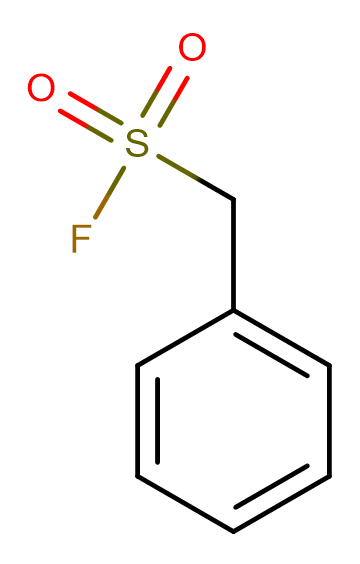
PMSF
CAS No. 329-98-6
PMSF( Benzylsulfonyl fluoride | NSC 88499 | PMSF )
Catalog No. M14093 CAS No. 329-98-6
PMSF (Phenylmethanesulfonyl fluoride) is an irreversible inhibitor of serine proteinases.
Purity : >98% (HPLC)
 COA
Datasheet
HNMR
HPLC
MSDS
Handing Instructions
COA
Datasheet
HNMR
HPLC
MSDS
Handing Instructions
| Size | Price / USD | Stock | Quantity |
| 1 mL x 10 mM in DMSO | 48 | In Stock |


|
| 50MG | 31 | In Stock |
|
| 100MG | 43 | In Stock |
|
| 200MG | 45 | In Stock |
|
| 500MG | 51 | In Stock |
|
| 1G | Get Quote | In Stock |
|
Biological Information
-
Product NamePMSF
-
NoteResearch use only, not for human use.
-
Brief DescriptionPMSF (Phenylmethanesulfonyl fluoride) is an irreversible inhibitor of serine proteinases.
-
DescriptionPMSF (Phenylmethanesulfonyl fluoride) is an irreversible inhibitor of serine proteinases, which is associated with the development of the delayed organophosphorus neuropathy. It has a role in a lot of cellular repair and regeneration processes in many kinds of tissues. PMSF is a long acting Neuropathy Target Esterase (NTE) inhibitor. NTE is a protection was related to inhibition of the putative target of organophosphate-induced delayed polyneuropathy (OPIDP). PMSF can increase NTE inhibition to more than 90%. PMSF also acts as an active site directed reagent for γ-glutamyl transpeptidase.(In Vitro):PMSF (2 mM) inhibits carbachol-stimulated inositol phosphate accumulation in the presence of Li+ by only 15%-19%. PMSF inhibition of phosphoinositide turnover is due to one or more steps following phosphoinositide breakdown. PMSF inhibits the acylation of the inositol residue of GPI intermediates in bloodstream form T. brucei. PMSF inhihits the formntion of glycolipid C but does not inhibit fatty acid remodeling in vitro. PMSF inhihits GPI acylation and ethanolamine phosphatp addition in procyclic trypanosomes but not in Hela cells. (In Vivo):PMSF (0.1 mL/10 g b.wt, i.p.) produces antinociception as indicated by the dose-responsive increase in % MPE in the tail-flick latency evaluation, but fails to produce a clear dose-responsive inhibition of locomotion. Mice receiving i.p. injections of PMSF exhibit cannabinoid effects that includes antinociception, hypothermia and immobility with ED50 values of 86, 224 and 206 mg/kg, respectively. PMSF (30 mg/kg) pretreatment potentiates the effects of anandamide on tail-flick response (antinociception), spontaneous activity and mobility by 5-, 10- and 8-fold, respectively.
-
In Vitro——
-
In Vivo——
-
SynonymsBenzylsulfonyl fluoride | NSC 88499 | PMSF
-
PathwayProteasome/Ubiquitin
-
TargetCysteine Protease
-
RecptorCysteine protease| Serine Protease
-
Research AreaInflammation/Immunology
-
Indication——
Chemical Information
-
CAS Number329-98-6
-
Formula Weight174.19
-
Molecular FormulaC7H7FO2S
-
Purity>98% (HPLC)
-
SolubilityEthanol: 15 mg/mL (86.11 mM); DMSO: 35 mg/mL (200.93 mM)
-
SMILESO=S(CC1=CC=CC=C1)(F)=O
-
Chemical NameBenzylsulfonyl fluoride
Shipping & Storage Information
-
Storage(-20℃)
-
ShippingWith Ice Pack
-
Stability≥ 2 years
Reference
1.Compton DR, et al. J Pharmacol Exp Ther, 1997, 283(3), 1138-1143.
molnova catalog



related products
-
Aurantiamide acetate
Aurantiamide acetate was isolated from the fermentation broth of Aspergillus penicilloides for the first time. Aurantiamide acetate is a selective and orally active cathepsin inhibitor. Aurantiamide acetate has anti-inflammatory activities and can be used for the study of inflammatory diseases.
-
Calpeptin
Calpeptin is a potent, cell-permeable calpain inhibitor with ID50 of 52 nM, 34 nM, 138 nM, and 40 nM for Calpain I (porcine erythrocytes), Calpain II (porcine kidney), Papainb, and Calpain I (human platelets), respectively.
-
SID 26681509
SID 26681509 is a selective, reversible and competitive human cathepsin L inhibitor (IC50 of 56 nM).
