


 Cart
Cart
 sales@molnova.com



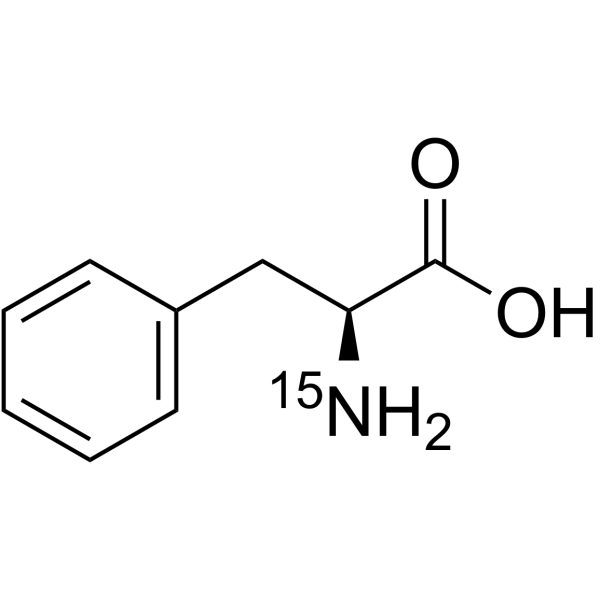
L-Phenylalanine-15N
CAS No. 29700-34-3
L-Phenylalanine-15N( (S)-2-Amino-3-phenylpropionic acid-15N )
Catalog No. M28293 CAS No. 29700-34-3
L-Phenylalanine-15N ((S)-2-Amino-3-phenylpropionic acid-15N) is the 15N-labeled L-Phenylalanine. L-Phenylalanine ((S)-2-Amino-3-phenylpropionic acid) is an essential amino acid isolated from Escherichia coli . L-Phenylalanine is a α2δ subunit of voltage-dependent Ca + channels antagonist with a K i of 980 nM.
Purity : >98% (HPLC)
 COA
Datasheet
HNMR
HPLC
MSDS
Handing Instructions
COA
Datasheet
HNMR
HPLC
MSDS
Handing Instructions
| Size | Price / USD | Stock | Quantity |
| 10MG | 38 | In Stock |


|
| 25MG | 60 | In Stock |
|
| 50MG | 86 | In Stock |
|
| 100MG | Get Quote | In Stock |
|
| 200MG | Get Quote | In Stock |
|
| 500MG | Get Quote | In Stock |
|
| 1G | Get Quote | In Stock |
|
Biological Information
-
Product NameL-Phenylalanine-15N
-
NoteResearch use only, not for human use.
-
Brief DescriptionL-Phenylalanine-15N ((S)-2-Amino-3-phenylpropionic acid-15N) is the 15N-labeled L-Phenylalanine. L-Phenylalanine ((S)-2-Amino-3-phenylpropionic acid) is an essential amino acid isolated from Escherichia coli . L-Phenylalanine is a α2δ subunit of voltage-dependent Ca + channels antagonist with a K i of 980 nM.
-
DescriptionL-Phenylalanine-15N ((S)-2-Amino-3-phenylpropionic acid-15N) is the 15N-labeled L-Phenylalanine. L-Phenylalanine ((S)-2-Amino-3-phenylpropionic acid) is an essential amino acid isolated from Escherichia coli . L-Phenylalanine is a α2δ subunit of voltage-dependent Ca + channels antagonist with a K i of 980 nM. L-phenylalanine is a competitive antagonist for the glycine- and glutamate-binding sites of N-methyl-D-aspartate receptors (NMDARs) ( K B of 573 μM ) and non-NMDARs , respectively. L-Phenylalanine is widely used in the production of food flavors and pharmaceuticals .(In Vitro):Stable heavy isotopes of hydrogen, carbon, and other elements have been incorporated into drug molecules, largely as tracers for quantitation during the drug development process. Deuteration has gained attention because of its potential to affect the pharmacokinetic and metabolic profiles of drugs .
-
In VitroStable heavy isotopes of hydrogen, carbon, and other elements have been incorporated into drug molecules, largely as tracers for quantitation during the drug development process. Deuteration has gained attention because of its potential to affect the pharmacokinetic and metabolic profiles of drugs.
-
In Vivo——
-
Synonyms(S)-2-Amino-3-phenylpropionic acid-15N
-
PathwayGPCR/G Protein
-
TargetCalcium Channel
-
RecptorTNF-α|PPARγ|inflammation|IL-12|IL-6
-
Research Area——
-
Indication——
Chemical Information
-
CAS Number29700-34-3
-
Formula Weight166.18
-
Molecular FormulaC9H11NO2
-
Purity>98% (HPLC)
-
Solubility——
-
SMILES[15NH2][C@@H](CC1=CC=CC=C1)C(O)=O
-
Chemical Name——
Shipping & Storage Information
-
Storage(-20℃)
-
ShippingWith Ice Pack
-
Stability≥ 2 years
Reference
1.Quang TH, et al. Inhibitory effects of oleanane-type triterpenes and saponins from the stem bark of Kalopanax pictus on LPS-stimulated pro-inflammatory cytokine production in bone marrow-derived dendritic cells. Arch Pharm Res. 2013 Mar;36(3):327-34.
molnova catalog



related products
-
AMG1
A novel specific CRAC channel inhibitor that blocks function of effector.
-
NNC 55-0396
A potent and selective T-type calcium channel antagonist that blocks recombinant alpha(1)G T-type channels in human embryonic kidney 293 cellswith IC50 of 7 uM.
-
TTA-Q6
TTA-Q6, a selective T-type Ca2+ channel antagonist, exhibits potential antitumor and immunomodulatory activities for treating neurological disorders by inhibiting the uptake of extracellular calcium ions by tumor cells, thereby inducing intracellular calcium deficiency and endoplasmic reticulum (ER) stress.
