


 Cart
Cart
 sales@molnova.com



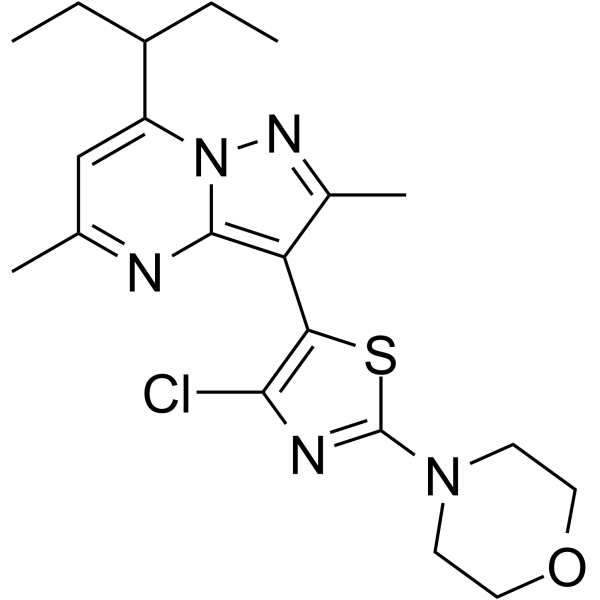
Tildacerfont
CAS No. 1014983-00-6
Tildacerfont( —— )
Catalog No. M27834 CAS No. 1014983-00-6
Tildacerfont is an antagonist of CRF1 and reduces the levels of adrenocorticotropic hormone and adrenal androgen. Tildacerfont can be used in studies about congenital adrenal hyperplasia.
Purity : >98% (HPLC)
 COA
Datasheet
HNMR
HPLC
MSDS
Handing Instructions
COA
Datasheet
HNMR
HPLC
MSDS
Handing Instructions
| Size | Price / USD | Stock | Quantity |
| 5MG | 183 | In Stock |


|
| 10MG | 280 | In Stock |
|
| 25MG | 565 | In Stock |
|
| 50MG | 877 | In Stock |
|
| 100MG | 1358 | In Stock |
|
| 200MG | Get Quote | In Stock |
|
| 500MG | Get Quote | In Stock |
|
| 1G | Get Quote | In Stock |
|
Biological Information
-
Product NameTildacerfont
-
NoteResearch use only, not for human use.
-
Brief DescriptionTildacerfont is an antagonist of CRF1 and reduces the levels of adrenocorticotropic hormone and adrenal androgen. Tildacerfont can be used in studies about congenital adrenal hyperplasia.
-
DescriptionTildacerfont is an antagonist of CRF1 and reduces the levels of adrenocorticotropic hormone and adrenal androgen. Tildacerfont can be used in studies about congenital adrenal hyperplasia.
-
In Vitro——
-
In Vivo——
-
Synonyms——
-
PathwayGPCR/G Protein
-
TargetCRF Receptor
-
Recptor——
-
Research Area——
-
Indication——
Chemical Information
-
CAS Number1014983-00-6
-
Formula Weight419.97
-
Molecular FormulaC20H26ClN5OS
-
Purity>98% (HPLC)
-
SolubilityIn Vitro:?DMSO : 10 mg/mL (23.81 mM)
-
SMILESCCC(CC)c1cc(C)nc2c(c(C)nn12)-c1sc(nc1Cl)N1CCOCC1
-
Chemical Name——
Shipping & Storage Information
-
Storage(-20℃)
-
ShippingWith Ice Pack
-
Stability≥ 2 years
Reference
1.Uhlenheuer DA, et al. Cucurbit[8]uril induced heterodimerization of methylviologen and naphthalene functionalized proteins. Chem Commun (Camb). 2011;47(24):6798-6800.
molnova catalog



related products
-
K 41498
Potent and highly selective CRF2 receptor antagonist (Ki values are 0.66, 0.62 and 425 nM for human CRF2α, CRF2β and CRF1 receptors respectively). Inhibits sauvagine-stimulated cAMP accumulation in hCRF2α- and hCRF2β-expressing cells. In rats in vivo, blocks urocortin-induced hypotension following systemic administration.
-
Urocortin, rat
Endogenous CRF agonist. Ki values are 13, 1.5 and 0.97 nM for hCRF1, rCRF2α and mCRF2β respectively.
-
CRF (6-33)
Corticotropin-releasing factor binding protein (CRFBP) inhibitor peptide; displaces CRF from CRFBP. Suppresses body weight gain and increases motor activity in obese rats in vivo.
