


 Cart
Cart
 sales@molnova.com



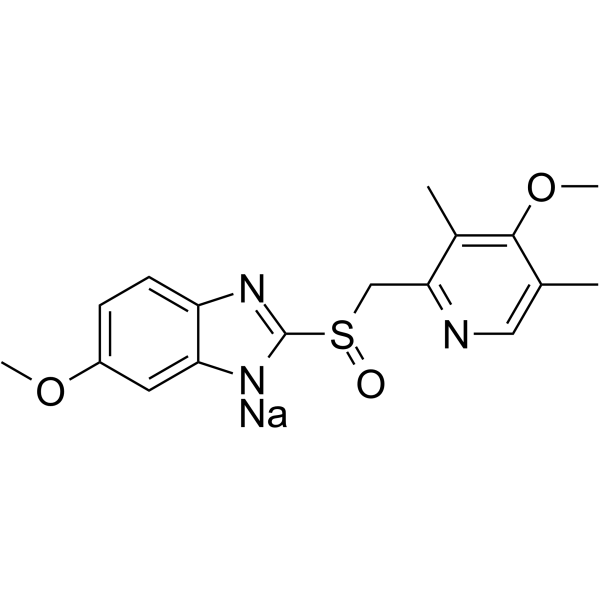
Omeprazole Sodium
CAS No. 95510-70-6
Omeprazole Sodium( H 16868 sodium )
Catalog No. M27570 CAS No. 95510-70-6
Omeprazole Sodium is a proton pump inhibitor(PPI) and suppresses gastric acid secretion. Omeprazole Sodium is a potent neutral sphingomyelinase (N-SMase) inhibitor (exosome inhibitor).
Purity : >98% (HPLC)
 COA
Datasheet
HNMR
HPLC
MSDS
Handing Instructions
COA
Datasheet
HNMR
HPLC
MSDS
Handing Instructions
| Size | Price / USD | Stock | Quantity |
| 1 mL x 10 mM in DMSO | 43 | In Stock |


|
| 100MG | 38 | In Stock |
|
| 200MG | 54 | In Stock |
|
| 500MG | 90 | In Stock |
|
| 1G | Get Quote | In Stock |
|
Biological Information
-
Product NameOmeprazole Sodium
-
NoteResearch use only, not for human use.
-
Brief DescriptionOmeprazole Sodium is a proton pump inhibitor(PPI) and suppresses gastric acid secretion. Omeprazole Sodium is a potent neutral sphingomyelinase (N-SMase) inhibitor (exosome inhibitor).
-
DescriptionOmeprazole Sodium is a proton pump inhibitor(PPI) and suppresses gastric acid secretion. Omeprazole Sodium is a potent neutral sphingomyelinase (N-SMase) inhibitor (exosome inhibitor). Omeprazole Sodium shows competitive inhibition of CYP2C19 activity with a Ki of 2 to 6 μM. Omeprazole Sodium inhibits growth of Gram-positive and Gram-negative bacteria.(In Vivo):Omeprazole Sodium virtually eliminated intragastric acidity in all patients: the median 24 hour intragastric pH rose from 1.4 to 5.3 and the mean hourly hydrogen ion activity fell from 38.50 to 1.95 mmol(mEq)/1 (p less than 0.001) .
-
In VitroOmeprazole (H 16868) is a proton pump inhibitor used in the treatment of dyspepsia, peptic ulcer disease, gastroesophageal reflux disease, laryngopharyngeal reflux, and Zollinger-Ellison syndrome. Omeprazole (H 16868) virtually eliminated intragastric acidity in all patients: the median 24 hour intragastric pH rose from 1.4 to 5.3 and the mean hourly hydrogen ion activity fell from 38.50 to 1.95 mmol(mEq)/1 (p less than 0.001). This inhibition of 24 hour intragastric acidity is more profound than that previously reported with either cimetidine 1 g daily or ranitidine 300 mg daily. The pharmacokinetics of omeprazole were studied in a group of healthy male subjects after single and repeated oral doses of 30 and 60 mg. Absorption of Omeprazole (H 16868) from its enteric-coated formulation was unpredictable. There was a highly significant increase in the area under the plasma concentration time curve (AUC) after repeated dosing. Omeprazole (H 16868) increases its own relative availability following repeated dosing. This may be due to inhibition of gastric acid secretion by omeprazole which is an acid-labile compound.Omeprazole sodium is a potent brain penetrant neutral sphingomyelinase (N-SMase) inhibitor (exosome inhibitor).
-
In Vivo——
-
SynonymsH 16868 sodium
-
PathwayMetabolic Enzyme/Protease
-
TargetP450
-
Recptor——
-
Research Area——
-
Indication——
Chemical Information
-
CAS Number95510-70-6
-
Formula Weight367.4
-
Molecular FormulaC17H18N3NaO3S
-
Purity>98% (HPLC)
-
SolubilityIn Vitro:?DMSO : 125 mg/mL (340.23 mM)
-
SMILESCOC1=CC2=C(C=C1)[N]([Na])C(=N2)[S](=O)CC3=NC=C(C)C(=C3C)OC
-
Chemical Name——
Shipping & Storage Information
-
Storage(-20℃)
-
ShippingWith Ice Pack
-
Stability≥ 2 years
Reference
1.Masanori Miwa, et al. Food Applications of Curdlan. Food Hydrocolloids pp 119-124.
molnova catalog



related products
-
TAK-700 (Orteronel)
Orteronel(TAK-700) was selected as a candidate for clinical evaluation.
-
Abiraterone Acetate
Abiraterone Acetate is an acetate salt form of Abiraterone which is a steroidal cytochrome CYP17 inhibitor with IC50 of 72 nM.
-
AS1810722
AS1810722 is an orally active and potent STAT6 inhibitor(IC50 :1.9 nM). AS1810722 shows a good profile of CYP3A4 inhibition. AS1810722, a derivative of fused bicyclic pyrimidine, has the potential for allergic diseases such as asthma and atopic diseases research.
