


 Cart
Cart
 sales@molnova.com



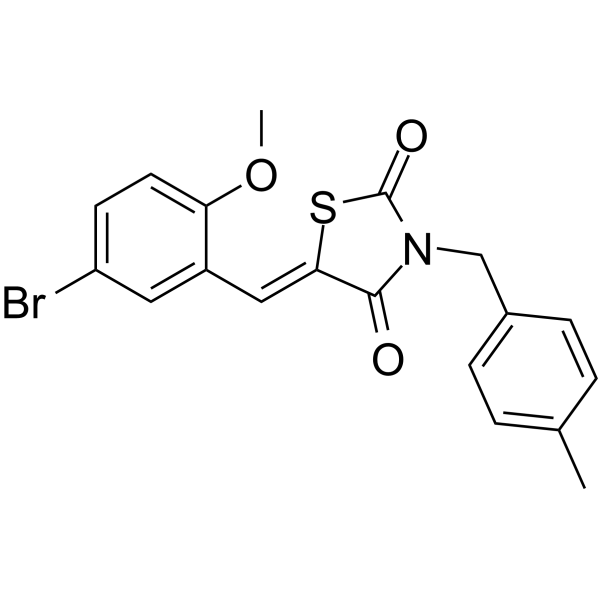
GQ-16
CAS No. 870554-67-9
GQ-16( —— )
Catalog No. M27488 CAS No. 870554-67-9
GQ-16 is a partial agonist of PPARγ with a Ki of 160 nM. GQ-16 reduces adipogenic actions and promotes insulin Sensitization without weight gain.
Purity : >98% (HPLC)
 COA
Datasheet
HNMR
HPLC
MSDS
Handing Instructions
COA
Datasheet
HNMR
HPLC
MSDS
Handing Instructions
| Size | Price / USD | Stock | Quantity |
| 1 mL x 10 mM in DMSO | 29 | In Stock |


|
| 10MG | 31 | In Stock |
|
| 25MG | 69 | In Stock |
|
| 50MG | 110 | In Stock |
|
| 100MG | 182 | In Stock |
|
| 200MG | 274 | In Stock |
|
| 500MG | 440 | In Stock |
|
| 1G | Get Quote | In Stock |
|
Biological Information
-
Product NameGQ-16
-
NoteResearch use only, not for human use.
-
Brief DescriptionGQ-16 is a partial agonist of PPARγ with a Ki of 160 nM. GQ-16 reduces adipogenic actions and promotes insulin Sensitization without weight gain.
-
DescriptionGQ-16 is a partial agonist of PPARγ with a Ki of 160 nM. GQ-16 reduces adipogenic actions and promotes insulin Sensitization without weight gain.
-
In Vitro——
-
In Vivo——
-
Synonyms——
-
PathwayMetabolic Enzyme/Protease
-
TargetPPAR
-
RecptorSyk
-
Research Area——
-
Indication——
Chemical Information
-
CAS Number870554-67-9
-
Formula Weight418.3
-
Molecular FormulaC19H16BrNO3S
-
Purity>98% (HPLC)
-
SolubilityIn Vitro:?DMSO : 10 mg/mL (23.91 mM)
-
SMILESCc1ccc(CN(C(/C(/S2)=C/c(cc(cc3)Br)c3OC)=O)C2=O)cc1
-
Chemical Name——
Shipping & Storage Information
-
Storage(-20℃)
-
ShippingWith Ice Pack
-
Stability≥ 2 years
Reference
1.International Nonproprietary Names for Pharmaceutical Substances (INN). WHO Drug Information, Vol. 31, No. 4, 2017.
molnova catalog



related products
-
Linotroban
Linotroban(CL-871502) is a potent selective thromboxane (TXA2) receptor antagonist with antithrombotic activity.
-
Chiglitazar
Chiglitazar (CS-038, CS038) is a potent, dual PPARα/γ dual agonist with EC50 of 1.2, 0.08, 1.7 uM for PPARα, PPARγ and PPARδ, respectively.
-
CGS 15435
CGS 15435 is a potent thromboxen (TxA2) synthetase inhibitor (IC50: 1 nM). CGS 15435 acts on PGI2 synthase, cyclooxygenase and liposynthase with much less selectivity than on thromboxin synthase.
