


 Cart
Cart
 sales@molnova.com



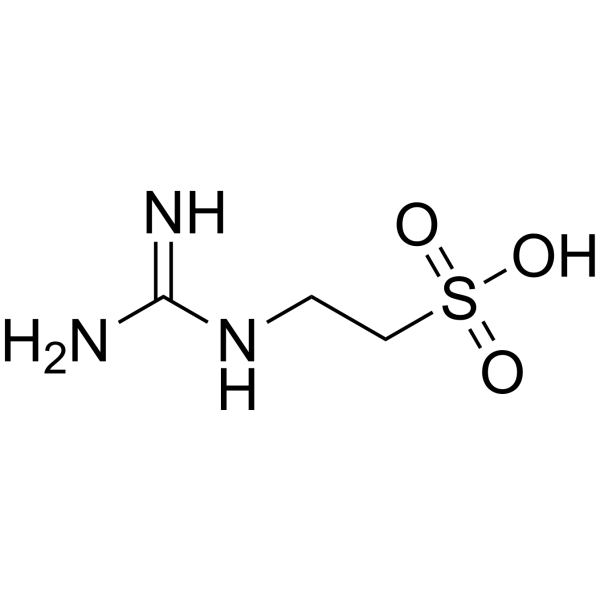
Guanidinoethyl sulfonate
CAS No. 543-18-0
Guanidinoethyl sulfonate( Taurocyamine )
Catalog No. M27436 CAS No. 543-18-0
Guanidinoethyl sulfonate is a competitive glycine receptor antagonist.
Purity : >98% (HPLC)
 COA
Datasheet
HNMR
HPLC
MSDS
Handing Instructions
COA
Datasheet
HNMR
HPLC
MSDS
Handing Instructions
| Size | Price / USD | Stock | Quantity |
| 50MG | 38 | In Stock |


|
| 100MG | 61 | In Stock |
|
| 200MG | 87 | In Stock |
|
| 500MG | 147 | In Stock |
|
| 1G | Get Quote | In Stock |
|
Biological Information
-
Product NameGuanidinoethyl sulfonate
-
NoteResearch use only, not for human use.
-
Brief DescriptionGuanidinoethyl sulfonate is a competitive glycine receptor antagonist.
-
DescriptionGuanidinoethyl sulfonate is a competitive glycine receptor antagonist.
-
In Vitro——
-
In Vivo——
-
SynonymsTaurocyamine
-
PathwayMembrane Transporter/Ion Channel
-
TargetChloride Channel
-
RecptorTopoisomerase
-
Research Area——
-
Indication——
Chemical Information
-
CAS Number543-18-0
-
Formula Weight167.18
-
Molecular FormulaC3H9N3O3S
-
Purity>98% (HPLC)
-
SolubilityIn Vitro:?H2O : 50 mg/mL (299.06 mM)
-
SMILESNC(=N)NCCS(O)(=O)=O
-
Chemical Name——
Shipping & Storage Information
-
Storage(-20℃)
-
ShippingWith Ice Pack
-
Stability≥ 2 years
Reference
1.Morimoto M, et al. Antifeedant activity of an anthraquinone aldehyde in Galium aparine L. against Spodoptera litura F. Phytochemistry. 2002 May;60(2):163-6.
molnova catalog



related products
-
NPPB
NPPB is a chloride channel blocker with IC50 of 80 nM .
-
DRAinh-A250
DRAinh-A250 is a specific inhibitor of Cl-/anion exchanger SLC26A3 (DRA).
-
Caftaric acid
Caftaric acid is an inhibitor of the protein-protein interactions mediated by the Src-family kinases.
