


 Cart
Cart
 sales@molnova.com



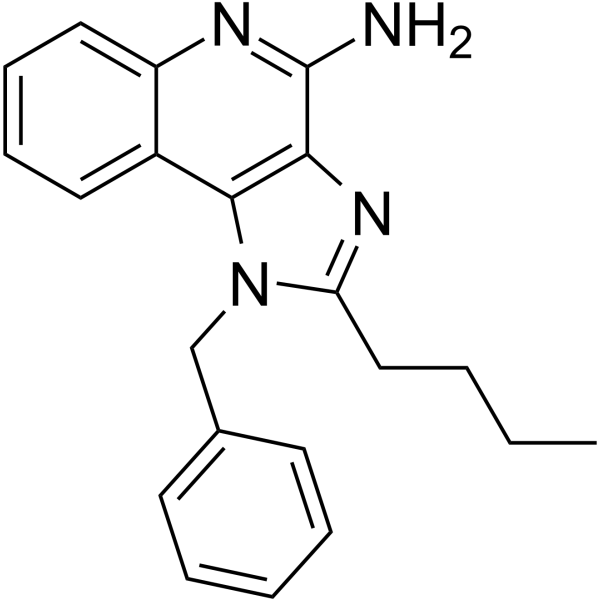
BBIQ
CAS No. 1229024-57-0
BBIQ( —— )
Catalog No. M26625 CAS No. 1229024-57-0
BBIQ is a powerful vaccine adjuvant that enhances innate immune responses and it is a imidazoquinoline compound and a potent and selectively toll-like receptor 7 (TLR7) agonist with an EC50 of 59.1 nM for human TLR7.
Purity : >98% (HPLC)
 COA
Datasheet
HNMR
HPLC
MSDS
Handing Instructions
COA
Datasheet
HNMR
HPLC
MSDS
Handing Instructions
| Size | Price / USD | Stock | Quantity |
| 1 mL x 10 mM in DMSO | 28 | In Stock |


|
| 25MG | 47 | In Stock |
|
| 100MG | Get Quote | In Stock |
|
| 200MG | Get Quote | In Stock |
|
| 500MG | Get Quote | In Stock |
|
| 1G | Get Quote | In Stock |
|
Biological Information
-
Product NameBBIQ
-
NoteResearch use only, not for human use.
-
Brief DescriptionBBIQ is a powerful vaccine adjuvant that enhances innate immune responses and it is a imidazoquinoline compound and a potent and selectively toll-like receptor 7 (TLR7) agonist with an EC50 of 59.1 nM for human TLR7.
-
DescriptionBBIQ is a powerful vaccine adjuvant that enhances innate immune responses[2] and it is a imidazoquinoline compound and a potent and selectively toll-like receptor 7 (TLR7) agonist with an EC50 of 59.1 nM for human TLR7.(In Vitro):BBIQ induces IFN-α in human PBMCs (520 pg/mL at 5 μg/mL).(In Vivo):In mice treated with Chloroquine (CQ) alone, parasite (P. berghei ANKA) appearesd on Day 17 and all mice of this group died by Day 21. Mice treated with BBIQ along with CQ exhibits no appearance of parasite till Day 23. Frequencies of T cells (CD3+, CD4+and CD8+) and T regulatory cells (CD4+, CD25 +and FoxP3+) are lower in brain of BBIQ + CQ treated mice as compared to BBIQ alone and CQ alone treated mice on Day 10. Serum levels of IFN-γ and IL-12 are higher on same day in mice treated with BBIQ + CQ which reveals the generation of strong Th1 immune response in mice against the infection. Inhibition of infiltration of inflammatory T cells and activation of T helper and T cytotoxic cells against the parasite is observed in the mice treated with this combination therapy.
-
In VitroBBIQ induces IFN-α in human PBMCs (520?pg/mL at 5?μg/mL).
-
In VivoIn mice treated with Chloroquine (CQ) alone, parasite (P. berghei ANKA) appearesd on Day 17 and all mice of this group died by Day 21. Whereas, mice treated with BBIQ along with CQ exhibits no appearance of parasite till Day 23. Frequencies of T cells (CD3+, CD4+and CD8+) and T regulatory cells (CD4+, CD25 +and FoxP3+) are lower in brain of BBIQ?+?CQ treated mice as compared to BBIQ alone and CQ alone treated mice on Day 10. Inhibition of infiltration of inflammatory T cells and activation of T helper and T cytotoxic cells against the parasite is observed in the mice treated with this combination therapy. Serum levels of IFN-γ and IL-12 are higher on same day in mice treated with BBIQ?+?CQ which reveals the generation of strong Th1 immune response in mice against the infection.
-
Synonyms——
-
PathwayImmunology/Inflammation
-
TargetTLR
-
RecptorB. anthracis| S. aureus
-
Research Area——
-
Indication——
Chemical Information
-
CAS Number1229024-57-0
-
Formula Weight330.435
-
Molecular FormulaC21H22N4
-
Purity>98% (HPLC)
-
SolubilityIn Vitro:?DMSO : 16.67 mg/mL (50.45 mM)
-
SMILESCCCCc1nc2c(N)nc3ccccc3c2n1Cc1ccccc1
-
Chemical Name——
Shipping & Storage Information
-
Storage(-20℃)
-
ShippingWith Ice Pack
-
Stability≥ 2 years
Reference
1.Guo J, et al. Isolation, characterization and antimicrobial activities of polyacetylene glycosides from Coreopsis tinctoria Nutt. Phytochemistry. 2017 Apr;136:65-69.
molnova catalog



related products
-
MMG-11
MMG-11 is a potent and selective human TLR2 antagonist with low cytotoxicity. MMG-11 inhibits both TLR2/1 and TLR2/6 signaling with IC50s of 1.7?μM for Pam3CSK4-induced hTLR2/1 and 5.7?μM for Pam2CSK4-induced hTLR2/6 responses.
-
TLR7/8 agonist 3
TLR7/8 agonist 3 is a potent agonist of TLR7 and TLR8.
-
Okanin
Okanin shows significant activities on both linoleic acid peroxidation inhibition and DPPH radical scavenging effect.
