


 Cart
Cart
 sales@molnova.com



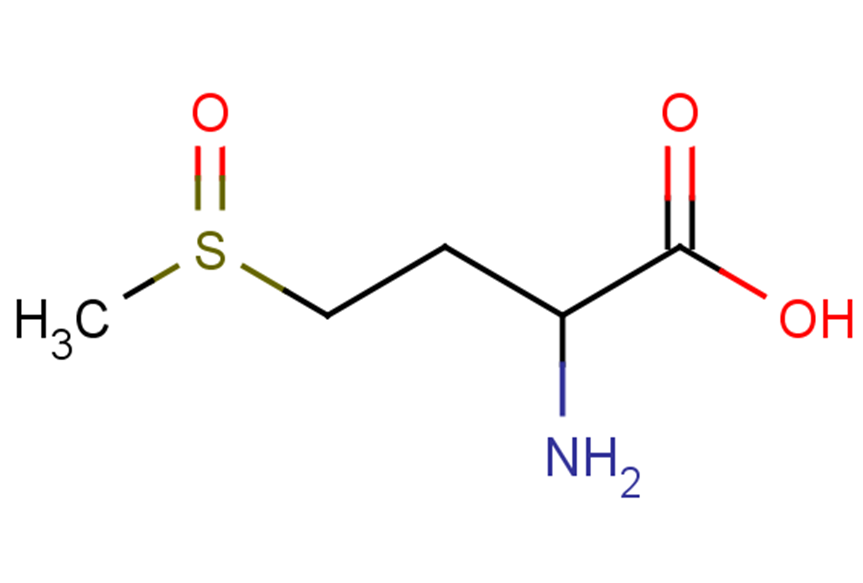
Methionine sulfoxide
CAS No. 62697-73-8
Methionine sulfoxide( —— )
Catalog No. M22467 CAS No. 62697-73-8
Methionine sulfoxide can be regarded as a biomarker of oxidative stress in vivo. Methionine sulfoxide is an oxidation product of methionine with reactive oxygen species.
Purity : >98% (HPLC)
 COA
Datasheet
HNMR
HPLC
MSDS
Handing Instructions
COA
Datasheet
HNMR
HPLC
MSDS
Handing Instructions
| Size | Price / USD | Stock | Quantity |
| 100MG | Get Quote | In Stock |


|
| 200MG | Get Quote | In Stock |
|
| 500MG | Get Quote | In Stock |
|
| 1G | 29 | In Stock |
|
Biological Information
-
Product NameMethionine sulfoxide
-
NoteResearch use only, not for human use.
-
Brief DescriptionMethionine sulfoxide can be regarded as a biomarker of oxidative stress in vivo. Methionine sulfoxide is an oxidation product of methionine with reactive oxygen species.
-
DescriptionMethionine sulfoxide can be regarded as a biomarker of oxidative stress in vivo. Methionine sulfoxide is an oxidation product of methionine with reactive oxygen species.
-
In Vitro——
-
In Vivo——
-
Synonyms——
-
PathwayProteasome/Ubiquitin
-
TargetEndogenous Metabolite
-
RecptorHuman Endogenous Metabolite
-
Research Area——
-
Indication——
Chemical Information
-
CAS Number62697-73-8
-
Formula Weight165.21
-
Molecular FormulaC5H11NO3S
-
Purity>98% (HPLC)
-
SolubilityH2O:250 mg/mL (1513.23 mM; Need ultrasonic)
-
SMILESCS(=O)CCC(N)C(O)=O
-
Chemical Name——
Shipping & Storage Information
-
Storage(-20℃)
-
ShippingWith Ice Pack
-
Stability≥ 2 years
Reference
1.Mashima R, et al. Simultaneous determination of methionine sulfoxide and methionine in blood plasma using gas chromatography-mass spectrometry. Anal Biochem. 2003 Feb 1;313(1):28-33.
molnova catalog



related products
-
Itaconic acid
Itaconic acid also known as itaconate belongs to the class of organic compounds known as branched fatty acids. These are fatty acids containing a branched chain. Itaconic acid exists as a solid soluble (in water) and a weakly acidic compound (based on its pKa). Itaconic acid has been detected in multiple biofluids such as sweat and urine.
-
2-Acetonaphthone
2-Acetylnaphthalene is a fragrance, anticonvulsant, and antimicrobial agent. It has an onion type flavor and a sulfurous type odor.
-
Estetrol
Estetrol(Donesta) is an orally available, selective modulator of the estrogen receptor, a naturally occurring estrogen synthesized by the human fetal liver during pregnancy.
