


 Cart
Cart
 sales@molnova.com



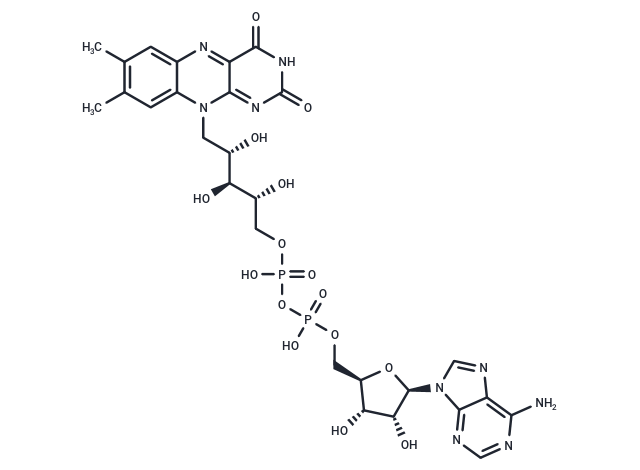
Flavin adenine dinucleotide
CAS No. 146-14-5
Flavin adenine dinucleotide( —— )
Catalog No. M35857 CAS No. 146-14-5
Flavin adenine dinucleotide (FAD) is a REDOX cofactor and protein cogroup involved in various metabolic reactions.
Purity : >98% (HPLC)
 COA
Datasheet
HNMR
HPLC
MSDS
Handing Instructions
COA
Datasheet
HNMR
HPLC
MSDS
Handing Instructions
| Size | Price / USD | Stock | Quantity |
| 5MG | 35 | In Stock |


|
| 10MG | 50 | In Stock |
|
| 25MG | 84 | In Stock |
|
| 50MG | 120 | In Stock |
|
| 100MG | 179 | In Stock |
|
| 200MG | Get Quote | In Stock |
|
| 500MG | Get Quote | In Stock |
|
| 1G | Get Quote | In Stock |
|
Biological Information
-
Product NameFlavin adenine dinucleotide
-
NoteResearch use only, not for human use.
-
Brief DescriptionFlavin adenine dinucleotide (FAD) is a REDOX cofactor and protein cogroup involved in various metabolic reactions.
-
DescriptionFlavin adenine dinucleotide (FAD) is a redox cofactor, more specifically a prosthetic group of a protein, involved in several important enzymatic reactions in metabolism.
-
In VitroPoly(Flavin adenine dinucleotide, FAD) characterized by an additional polymer-type redox reaction is a highly effective electrocatalyst for NADH oxidation: operating at the lowest potentials reported for NADH transducers (0.00 V, pH 7.4), poly(FAD) is characterized by the electrochemical rate constant of 1.8 ± 0.6×10⁻³ cm/s, which is at the level of the NADH mass-transfer constant. Poly(FAD)-modified electrodes are characterized by the dramatically improved stability and, is the most advantageous NADH transducers for analytical chemistry.
-
In VivoFlavin adenine dinucleotide (2 mg/kg, i.v.) significantly cancels chlorpromazine (CPZ)-induced decrease in ventricular fibrillation threshold (VFT). Flavin adenine dinucleotide cancels the effect of CPZ on canine heart mitochondria. After injection of Flavin adenine dinucleotide, the dogs show a transient hypotension within 10 min, then their blood pressures recover to the initial level. Flavin adenine dinucleotide also prevents mitochondrial dysfunction induced by chlorpromazine.
-
Synonyms——
-
PathwayProteasome/Ubiquitin
-
TargetEndogenous Metabolite
-
RecptorEndogenous Metabolite
-
Research Area——
-
Indication——
Chemical Information
-
CAS Number146-14-5
-
Formula Weight785.55
-
Molecular FormulaC27H33N9O15P2
-
Purity>98% (HPLC)
-
SolubilityIn Vitro:?H2O : 125 mg/mL (159.12 mM; Ultrasonic)
-
SMILESC([C@@H]([C@@H]([C@@H](COP(OP(OC[C@H]1O[C@H]([C@H](O)[C@@H]1O)N2C=3C(N=C2)=C(N)N=CN3)(=O)O)(=O)O)O)O)O)N4C=5C(=NC=6C4=CC(C)=C(C)C6)C(=O)NC(=O)N5
-
Chemical Name——
Shipping & Storage Information
-
Storage(-20℃)
-
ShippingWith Ice Pack
-
Stability≥ 2 years
Reference
1. Sugiyama S, et al. Protection of chlorpromazine-induced arrhythmia by flavin-adenine-dinucleotide in canine heart. Jpn Heart J. 1979 Sep;20(5):657-65.?
molnova catalog



related products
-
7-Ketolithocholic ac...
7-Ketolithocholic acid (3α-Hydroxy-7-oxo-5β-cholanic acid) can be absorbed and suppresses endogenous bile acid production and biliary cholesterol secretion.
-
(L)-Dehydroascorbic ...
L-Dehydro Ascorbic Acid is the reversibly oxidized form of ascorbic acid;Dehydroascorbic acid a blood-brain barrier transportable form of vitamin C mediates potent cerebroprotection in experimental stroke.
-
(±)-Propionylcarniti...
(±)-Propionylcarnitine chloride (Propionyl-DL-carnitine chloride) is a mixture of short-chain acylcarnitines used as a dietary supplement for the study of chronic diabetes.
