


 Cart
Cart
 sales@molnova.com



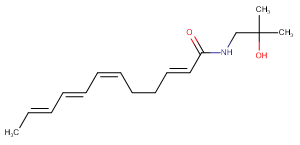
Hydroxy-?α-?sanshool
CAS No. 83883-10-7
Hydroxy-?α-?sanshool( —— )
Catalog No. M21545 CAS No. 83883-10-7
Hydroxy- α- sanshool is an alkyl amide isolated from the pepper. It acts as a TRPA1 covalent and TRPV1 non-covalent agonist (EC50s: 69 and 1.1 μM).
Purity : >98% (HPLC)
 COA
Datasheet
HNMR
HPLC
MSDS
Handing Instructions
COA
Datasheet
HNMR
HPLC
MSDS
Handing Instructions
| Size | Price / USD | Stock | Quantity |
| 1 mL x 10 mM in DMSO | 170 | In Stock |


|
| 5MG | 155 | In Stock |
|
| 10MG | 250 | In Stock |
|
| 25MG | 424 | In Stock |
|
| 50MG | 600 | In Stock |
|
| 100MG | 824 | In Stock |
|
| 200MG | Get Quote | In Stock |
|
| 500MG | Get Quote | In Stock |
|
| 1G | Get Quote | In Stock |
|
Biological Information
-
Product NameHydroxy-?α-?sanshool
-
NoteResearch use only, not for human use.
-
Brief DescriptionHydroxy- α- sanshool is an alkyl amide isolated from the pepper. It acts as a TRPA1 covalent and TRPV1 non-covalent agonist (EC50s: 69 and 1.1 μM).
-
DescriptionHydroxy- α- sanshool is an alkyl amide isolated from the pepper. It acts as a TRPA1 covalent and TRPV1 non-covalent agonist (EC50s: 69 and 1.1 μM).
-
In VitroHydroxy-α-sanshool (0-10 mM; 20 s) induces inward currents in cultured DRG neuron.Hydroxy-α-sanshool (1 mM; 0-1 min) increases intracellular Ca2+ in cultured DRG neuron. Cell Viability Assay Cell Line:Dorsal root ganglion (DRG) neurons Concentration:0-10 mM Incubation Time:20 s Result:Induced small but robust inward currents for DRG neuron with an EC50 of 66.2 μM.Cell Viability Assay Cell Line:Dorsal root ganglion (DRG) neurons Concentration:1 mM Incubation Time:0-1 min Result:Led to an intracellular Ca2+ increase in the majority of DRG neurons tested (98 of 100).
-
In VivoHydroxy-α-sanshool (intradermal injection; 4 mg per mouse; once) shows paw-licking response in wild-type and TRPV1-deficient mice.Hydroxy-α-sanshool (1 mM) ismarkedly aversive to WT mice, but in TRPV1 KO mice, the aversion is almost entirely eliminated (P<0.001). Animal Model:Wild-type and TRPV1-deficient mice Dosage:4 mg per mouse Administration:Intradermal injection; 4 mg per mouse; once Result:Reduced paw-licking response in TRPV1-deficient mice (160 times, P < 0.05).Showed paw-licking response in wild-type mice (mean 284.8 times) in 20 min.
-
Synonyms——
-
PathwayMembrane Transporter/Ion Channel
-
TargetTRP/TRPV Channel
-
RecptorTRPA1| TRPV1
-
Research Area——
-
Indication——
Chemical Information
-
CAS Number83883-10-7
-
Formula Weight263.37
-
Molecular FormulaC16H25NO2
-
Purity>98% (HPLC)
-
SolubilityIn Vitro:?DMSO : 100 mg/mL (379.68 mM)
-
SMILESCC(C)(CNC(/C=C/CC/C=C\C=C\C=C\C)=O)O
-
Chemical Name——
Shipping & Storage Information
-
Storage(-20℃)
-
ShippingWith Ice Pack
-
Stability≥ 2 years
Reference
1.Koo JY et al. Compounds from Sichuan and Melegueta peppers activate covalently and non-covalently TRPA1 and TRPV1 channels. Br J Pharmacol. 2009 Aug;157(8):1398-409.
molnova catalog



related products
-
RN-1747
RN-1747 is a selective transient receptor potential cation channel subfamily V member 4 agonists (EC50: hTRPV4 of 0.77 μM, mTRPV4 of 4.0 μM, and rTRPV4 of 4.1 μM). RN-1747 also antagonizes TRPM8 (IC50: 4 μM).
-
Adenosine 5-diphosph...
Adenosine 5'-diphosphoribose sodium (ADP ribose sodium) is a metabolite of nicotinamide adenine nucleotide (NAD+), which is widely present in organisms.
-
Capsaicin
Capsaicin is an active component of chili peppers. It selectively binds to TRPV1 which is a heat-activated calcium channel.
