


 Cart
Cart
 sales@molnova.com



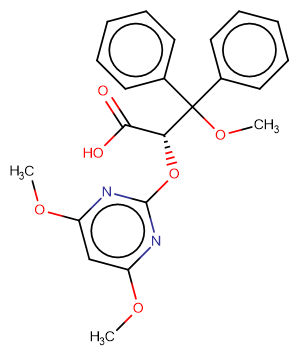
Darusentan
CAS No. 171714-84-4
Darusentan( Lu-135252 )
Catalog No. M20203 CAS No. 171714-84-4
Darusentan is a potent inhibitor of endothelin signaling and function in both large and small arteries.
Purity : >98% (HPLC)
 COA
Datasheet
HNMR
HPLC
MSDS
Handing Instructions
COA
Datasheet
HNMR
HPLC
MSDS
Handing Instructions
| Size | Price / USD | Stock | Quantity |
| 1 mL x 10 mM in DMSO | 62 | In Stock |


|
| 2MG | 36 | In Stock |
|
| 5MG | 60 | In Stock |
|
| 10MG | 102 | In Stock |
|
| 25MG | 183 | In Stock |
|
| 50MG | 297 | In Stock |
|
| 100MG | 429 | In Stock |
|
| 200MG | 603 | In Stock |
|
| 500MG | Get Quote | In Stock |
|
| 1G | Get Quote | In Stock |
|
Biological Information
-
Product NameDarusentan
-
NoteResearch use only, not for human use.
-
Brief DescriptionDarusentan is a potent inhibitor of endothelin signaling and function in both large and small arteries.
-
DescriptionDarusentan is a potent inhibitor of endothelin signaling and function in both large and small arteries.(In Vitro):Darusentan ((S)-Darusentan) competes for radiolabeled endothelin binding in rat aortic vascular smooth muscle cells (RAVSMs) membranes with single-site kinetics, exhibiting a Ki=13 nM. In isolated endothelium-denuded rat aortic rings, Darusentan inhibits endothelin-induced vascular contractility with a pA2=8.1±0.14. Darusentan ( 0.001-1μM) inhibits ET-1-induced signaling in cultured RAVSMs.(In Vivo):Darusentan (30 mg/kg per day orally for weeks 3 and 4) reverses aortic alterations produced by infusion of Norepinephrine (2.5 μg/kg per min subcutaneously for 2 and 4 weeks) in male Sprague Dawley rats.
-
In VitroDarusentan ((S)-Darusentan) competes for radiolabeled endothelin binding in rat aortic vascular smooth muscle cells (RAVSMs) membranes with single-site kinetics, exhibiting a Ki=13 nM. In isolated endothelium-denuded rat aortic rings, Darusentan inhibits endothelin-induced vascular contractility with a pA2=8.1±0.14. Darusentan ( 0.001-1μM) inhibits ET-1-induced signaling in cultured RAVSMs.
-
In VivoDarusentan (30 mg/kg per day orally for weeks 3 and 4) reverses aortic alterations produced by infusion of Norepinephrine (2.5 μg/kg per min subcutaneously for 2 and 4 weeks) in male Sprague Dawley rats. Animal Model:Twenty-four (eight per group) male Sprague Dawley rats weighing 175±200 g Dosage:30 mg/kg Administration:Administered orally in rat food for weeks 3 and 4 Result:Reversed aortic alterations produced by infusion of Norepinephrine (2.5 μg/kg).
-
SynonymsLu-135252
-
PathwayProteasome/Ubiquitin
-
TargetEndogenous Metabolite
-
RecptorEndothelin A receptor
-
Research AreaMetabolic Disease
-
IndicationArrhythmias; Diabetic angiopathies; Diabetic nephropathies; Heart failure; Ischaemic heart disorders
Chemical Information
-
CAS Number171714-84-4
-
Formula Weight410.43
-
Molecular FormulaC22H22N2O6
-
Purity>98% (HPLC)
-
SolubilityDMSO:125 mg/mL (304.57 mM);Water:Insoluble
-
SMILESCOc1cc(OC)nc(O[C@H](C(O)=O)C(OC)(c2ccccc2)c2ccccc2)n1
-
Chemical Name(S)-2-((46-Dimethoxy-2-pyrimidinyl)oxy)-3-methoxy-33-diphenylpropionic acid
Shipping & Storage Information
-
Storage(-20℃)
-
ShippingWith Ice Pack
-
Stability≥ 2 years
Reference
1.Liang F et al. Darusentan is a potent inhibitor of endothelin signaling and function in both large and small arteries. Can J Physiol Pharmacol. 2010 Aug;88(8):840-9.
molnova catalog



related products
-
3-Hydroxycapric acid
3-hydroxydecanoic acid is a medium-chain fatty acid.?It has a role as an antimitotic and an Escherichia coli metabolite.
-
Allolithocholic acid
Allolithocholic acid (allo-LCA) is found in the urine of infants with biliary atresia and is often excreted as sulfate-conjugated bile acids.Allolithocholic acid promotes intestinal and hepatic metabolism.
-
1-Methyl-L-histidine
Natural but non-proteinogenic amino acid; employed as index of muscle protein breakdown.
