


 Cart
Cart
 sales@molnova.com



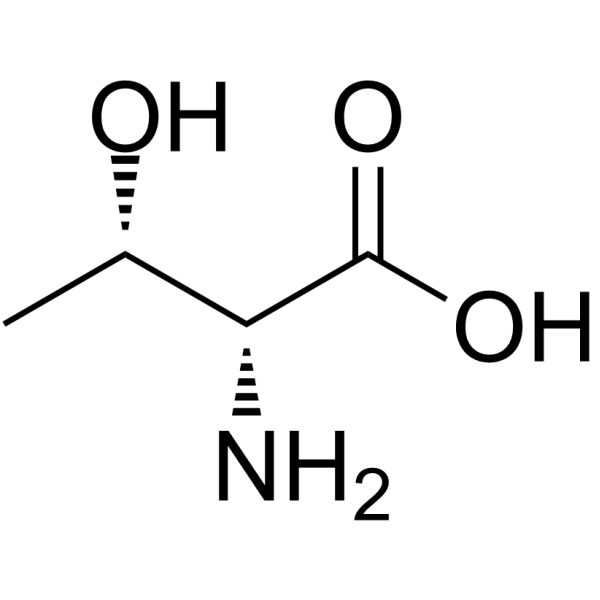
D-Threonine
CAS No. 632-20-2
D-Threonine( H-D-Thr-OH )
Catalog No. M28329 CAS No. 632-20-2
D-Threonine is one of the metabolites of Saccharomyces cerevisiae.
Purity : >98% (HPLC)
 COA
Datasheet
HNMR
HPLC
MSDS
Handing Instructions
COA
Datasheet
HNMR
HPLC
MSDS
Handing Instructions
| Size | Price / USD | Stock | Quantity |
| 100MG | Get Quote | In Stock |


|
| 200MG | Get Quote | In Stock |
|
| 500MG | Get Quote | In Stock |
|
| 1G | 29 | In Stock |
|
Biological Information
-
Product NameD-Threonine
-
NoteResearch use only, not for human use.
-
Brief DescriptionD-Threonine is one of the metabolites of Saccharomyces cerevisiae.
-
DescriptionD-Threonine is one of the metabolites of Saccharomyces cerevisiae.
-
In Vitro——
-
In Vivo——
-
SynonymsH-D-Thr-OH
-
PathwayProteasome/Ubiquitin
-
TargetEndogenous Metabolite
-
Recptor——
-
Research Area——
-
Indication——
Chemical Information
-
CAS Number632-20-2
-
Formula Weight119.12
-
Molecular FormulaC4H9NO3
-
Purity>98% (HPLC)
-
SolubilityIn Vitro:?H2O : 100 mg/mL (839.49 mM)
-
SMILESC[C@@H]([C@H](C(O)=O)N)O
-
Chemical Name——
Shipping & Storage Information
-
Storage(-20℃)
-
ShippingWith Ice Pack
-
Stability≥ 2 years
Reference
1.Moya C, et al. Tuning the magnetic properties of Co-ferrite nanoparticles through the 1,2-hexadecanediol concentration in the reaction mixture. Phys Chem Chem Phys. 2015 May 21;17(19):13143-9.
molnova catalog



related products
-
Ochratoxin B
Ochratoxin B is produced by a variety of Aspergillus and Penicillium species and is an analog of the mycotoxin Ochratoxin A, which can contaminate agricultural products.
-
Arcyriaflavin A
Arcyriaflavin A is derived from Eudistoma sp. It inhibits D1-CDK4, B-CDK1 and CaMKII with IC50 values ??of 0.14μM, 1.13μM and 0.025μM, respectively.
-
Oleamide
Oleamide (Oleic acid amide) is an endogenous fatty acid amide and can be used in the synthesis of de novo in the mammalian nervous system.
