


 Cart
Cart
 sales@molnova.com



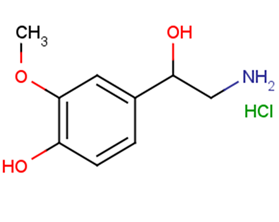
DL-Normetanephrine hydrochloride
CAS No. 1011-74-1
DL-Normetanephrine hydrochloride( —— )
Catalog No. M19734 CAS No. 1011-74-1
rac-Normetanephrine Hydrochloride is a metabolite of Epinephrine. It is found together with Metanephrine in urine and in certain tissues.
Purity : >98% (HPLC)
 COA
Datasheet
HNMR
HPLC
MSDS
Handing Instructions
COA
Datasheet
HNMR
HPLC
MSDS
Handing Instructions
| Size | Price / USD | Stock | Quantity |
| 1 mL x 10 mM in DMSO | 61 | In Stock |


|
| 5MG | 59 | In Stock |
|
| 10MG | 85 | In Stock |
|
| 25MG | 170 | In Stock |
|
| 50MG | 276 | In Stock |
|
| 100MG | Get Quote | In Stock |
|
| 200MG | Get Quote | In Stock |
|
| 500MG | Get Quote | In Stock |
|
| 1G | Get Quote | In Stock |
|
Biological Information
-
Product NameDL-Normetanephrine hydrochloride
-
NoteResearch use only, not for human use.
-
Brief Descriptionrac-Normetanephrine Hydrochloride is a metabolite of Epinephrine. It is found together with Metanephrine in urine and in certain tissues.
-
Descriptionrac-Normetanephrine Hydrochloride is a metabolite of Epinephrine. It is found together with Metanephrine in urine and in certain tissues.
-
In VitroNormetanephrine hydrochloride is a norepinephrine metabolite that contains one more methyl group than norepinephrine.
-
In Vivo——
-
Synonyms——
-
PathwayProteasome/Ubiquitin
-
TargetEndogenous Metabolite
-
RecptorHuman Endogenous Metabolite
-
Research Area——
-
Indication——
Chemical Information
-
CAS Number1011-74-1
-
Formula Weight219.66
-
Molecular FormulaC9H14ClNO3
-
Purity>98% (HPLC)
-
SolubilityDMSO:10 mM
-
SMILESCl.COc1cc(ccc1O)C(O)CN
-
Chemical Name——
Shipping & Storage Information
-
Storage(-20℃)
-
ShippingWith Ice Pack
-
Stability≥ 2 years
Reference
1.Eisenhofer G. et al.: J. Clin. Endocrinol. Metab. 82 3864 (1997) .
molnova catalog



related products
-
Cinnamic acid (b)
Cinnamic acid has potential use in cancer interventionThe concentration causing a 50% reduction of cell proliferation (IC50) ranged from 1 to 4.5 mM in glioblastoma melanoma prostate and lung carcinoma cells.
-
D-Ribonolactone
D-Ribonolactone is sugar lactone and an inhibitor of β-galactosidase of Escherichia coli (Ki : 26 Mm).
-
Arcyriaflavin A
Arcyriaflavin A is derived from Eudistoma sp. It inhibits D1-CDK4, B-CDK1 and CaMKII with IC50 values ??of 0.14μM, 1.13μM and 0.025μM, respectively.
