


 Cart
Cart
 sales@molnova.com



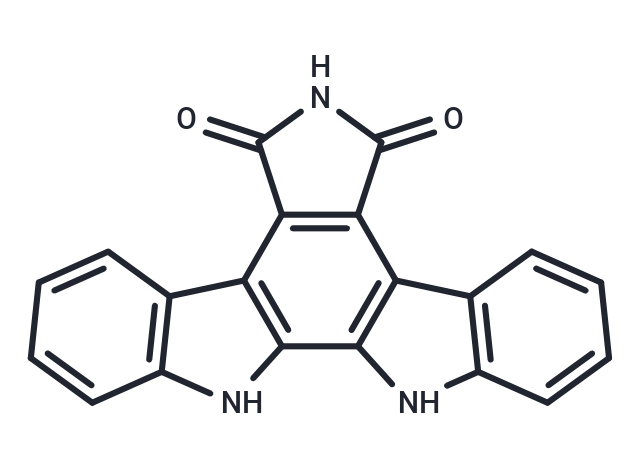
Arcyriaflavin A
CAS No. 118458-54-1
Arcyriaflavin A( —— )
Catalog No. M33768 CAS No. 118458-54-1
Arcyriaflavin A is derived from Eudistoma sp. It inhibits D1-CDK4, B-CDK1 and CaMKII with IC50 values of 0.14μM, 1.13μM and 0.025μM, respectively.
Purity : >98% (HPLC)
 COA
Datasheet
HNMR
HPLC
MSDS
Handing Instructions
COA
Datasheet
HNMR
HPLC
MSDS
Handing Instructions
| Size | Price / USD | Stock | Quantity |
| 5MG | 107 | In Stock |


|
| 10MG | 172 | In Stock |
|
| 25MG | 306 | In Stock |
|
| 50MG | 465 | In Stock |
|
| 100MG | Get Quote | In Stock |
|
| 200MG | Get Quote | In Stock |
|
| 500MG | Get Quote | In Stock |
|
| 1G | Get Quote | In Stock |
|
Biological Information
-
Product NameArcyriaflavin A
-
NoteResearch use only, not for human use.
-
Brief DescriptionArcyriaflavin A is derived from Eudistoma sp. It inhibits D1-CDK4, B-CDK1 and CaMKII with IC50 values of 0.14μM, 1.13μM and 0.025μM, respectively.
-
DescriptionArcyriaflavin A is a fungal metabolite obtained from the fungi, Nocardiopsis. Arcyriaflavin A is an inhibitor of CDK4 (IC50 = 140 nM) and CaMKII (IC50 = 25 nM).
-
In Vitro——
-
In Vivo——
-
Synonyms——
-
PathwayProteasome/Ubiquitin
-
TargetEndogenous Metabolite
-
RecptorEndogenous Metabolite
-
Research Area——
-
Indication——
Chemical Information
-
CAS Number118458-54-1
-
Formula Weight325.32
-
Molecular FormulaC20H11N3O2
-
Purity>98% (HPLC)
-
Solubility——
-
SMILESO=C1NC(=O)C2=C1C1=C(NC3=C1C=CC=C3)C1=C2C2=C(N1)C=CC=C2
-
Chemical Name——
Shipping & Storage Information
-
Storage(-20℃)
-
ShippingWith Ice Pack
-
Stability≥ 2 years
Reference
1. P A Horton, et al. Staurosporine aglycone (K252-c) and arcyriaflavin A from the marine ascidian, Eudistoma sp. Experientia. 1994 Sep 15;50(9):843-5.?
molnova catalog



related products
-
N6-Isopentenyladenos...
N6-Isopentenyladenosine, an end product of the mevalonate pathway, is an autophagy inhibitor with anti-melanoma activity. N6-Isopentenyladenosine, an RNA modification found in cytokinins, regulates plant growth/differentiation and improves the efficiency
-
3-Ureidopropionic ac...
Ureidopropionic acid is an intermediate in the metabolism of uracil. More specifically it is a breakdown product of dihydrouracil and is produced by the enzyme dihydropyrimidase.
-
trans-Aconitic acid
Trans-Aconitic acid is normally present in normal human urine and it has been suggested that is present in larger amounts with Reye's syndrome and organic aciduria. trans-Aconitic acid is a substrate of enzyme trans-aconitate 2-methyltransferase (EC 2.1.1.144).
