


 Cart
Cart
 sales@molnova.com



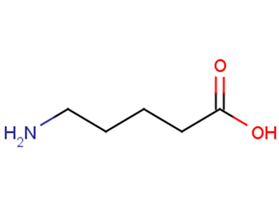
5-Aminovaleric acid
CAS No. 660-88-8
5-Aminovaleric acid( —— )
Catalog No. M19658 CAS No. 660-88-8
5-aminovalerate (or 5-aminopentanoic acid) is a lysine degradation product. It can be produced both endogenously or through bacterial catabolism of lysine.
Purity : >98% (HPLC)
 COA
Datasheet
HNMR
HPLC
MSDS
Handing Instructions
COA
Datasheet
HNMR
HPLC
MSDS
Handing Instructions
| Size | Price / USD | Stock | Quantity |
| 100MG | Get Quote | In Stock |


|
| 200MG | Get Quote | In Stock |
|
| 500MG | Get Quote | In Stock |
|
| 1G | 27 | In Stock |
|
Biological Information
-
Product Name5-Aminovaleric acid
-
NoteResearch use only, not for human use.
-
Brief Description5-aminovalerate (or 5-aminopentanoic acid) is a lysine degradation product. It can be produced both endogenously or through bacterial catabolism of lysine.
-
Description5-aminovalerate (or 5-aminopentanoic acid) is a lysine degradation product. It can be produced both endogenously or through bacterial catabolism of lysine. 5-aminovalerate is formed via the following multi-step reaction: L-lysine leads to cadverine leads to L-piperideine leads 5-aminovalerate . In other words it is a metabolite of cadaverine which is formed via the intermediate 1-piperideine. Cadaverine is a foul-smelling diamine compound produced by protein hydrolysis during putrefaction of animal tissue. High levels of 5-aminovalerate in biofluids may indicate bacterial overgrowth or endogenous tissue necrosis. In most cases endogenous 5-aminovalerate is thought to be primarily a microbial metabolite produced by the gut or oral microflora although it can be produced endogenously. 5-aminopentanoic acid is an in vivo substrate of 4-aminobutyrate:2-oxoglutarate aminotransferase .
-
In Vitro5-Aminovaleric acid is a normal metabolite present in human saliva, with a tendency to elevated concentration in patients with chronic periodontitis. 5-Aminovaleric acid is also believed to act as a methylene homologue of gamma-aminobutyric acid (GABA) and functions as a weak GABA agonist.It is also known as an antifibrinolytic amino acid analog and so it functions as a weak inhibitor of the blood clotting pathway.
-
In Vivo——
-
Synonyms——
-
PathwayProteasome/Ubiquitin
-
TargetEndogenous Metabolite
-
Recptorothers
-
Research Area——
-
Indication——
Chemical Information
-
CAS Number660-88-8
-
Formula Weight117.15
-
Molecular FormulaC5H11NO2
-
Purity>98% (HPLC)
-
SolubilityDMSO:10 mM
-
SMILESNCCCCC(O)=O
-
Chemical Name——
Shipping & Storage Information
-
Storage(-20℃)
-
ShippingWith Ice Pack
-
Stability≥ 2 years
Reference
1.Santos A Zanetta S Cresteil T et al. Metabolism of irinotecan (CPT-11) by CYP3A4 and CYP3A5 in humans[J]. Clinical Cancer Research 2000 6(5):2012-2020.
molnova catalog



related products
-
3-?Oxocholic acid
3-Oxocholic acid(3-Ketocholic acid) is the metabolite of bile acid and the main product of bile degradation by Clostridium perfringens in the intestine.3-Oxocholic acid is a steroid acid mainly found in the bile of mammals.
-
Succinyl phosphonate
Succinyl phosphonate is a selective α-ketoglutarate dehydrogenase (α-KGDHC?) and OGDHC inhibitor that inhibits α-ketoglutarate oxidative decarboxylation.
-
7-Dehydrocholesterol
7-Dehydrocholesterol down-regulates cholesterol biosynthesis in cultured Smith-Lemi-Opitz syndrome skin fibroblasts.
