


 Cart
Cart
 sales@molnova.com



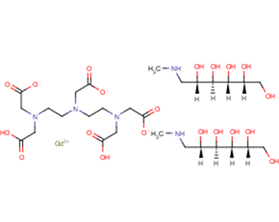
Gadopentetate dimeglumine
CAS No. 86050-77-3
Gadopentetate dimeglumine( SH-L-451A | Gadopentetic acid dimeglumine salt )
Catalog No. M19187 CAS No. 86050-77-3
Gadopentetate dimeglumine, an extracellular intravenous contrast agent, is used in combination with magnetic resonance imaging (MRI) to allow blood vessels, organs, and other non-bony tissues to be seen more clearly on the MRI.
Purity : >98% (HPLC)
 COA
Datasheet
HNMR
HPLC
MSDS
Handing Instructions
COA
Datasheet
HNMR
HPLC
MSDS
Handing Instructions
| Size | Price / USD | Stock | Quantity |
| 100MG | 32 | In Stock |


|
| 200MG | 54 | In Stock |
|
| 500MG | Get Quote | In Stock |
|
| 1G | Get Quote | In Stock |
|
Biological Information
-
Product NameGadopentetate dimeglumine
-
NoteResearch use only, not for human use.
-
Brief DescriptionGadopentetate dimeglumine, an extracellular intravenous contrast agent, is used in combination with magnetic resonance imaging (MRI) to allow blood vessels, organs, and other non-bony tissues to be seen more clearly on the MRI.
-
DescriptionGadopentetate dimeglumine, an extracellular intravenous contrast agent, is used in combination with magnetic resonance imaging (MRI) to allow blood vessels, organs, and other non-bony tissues to be seen more clearly on the MRI.(In Vitro):Gadobenate dimeglumine-enhanced MRI significantly improves cancer detection compared to gadopentetate dimeglumine-enhanced MRI, mammography, and ultrasound in a selected group of patients undergoing breast MRI for preoperative staging or because of inconclusive findings at conventional imaging. Interstitial MR lymphography with gadopentetate dimeglumine (Gd-DTPA) or gadoxetate disodium (Gd-EOB-DTPA) allows clear visualization of the lymphatic pathway in healthy mice, and no significant difference is found between the two agents. Their rapid kinetics limits the imaging timing window, however, facilitates repeated assessment in a single imaging session. Direct visualization of spilled gastrointestinal gadopentetate dimeglumine helps discriminate ischemic from control rats in this model.
-
In VitroGadobenate dimeglumine-enhanced MRI significantly improves cancer detection compared to gadopentetate dimeglumine-enhanced MRI, mammography, and ultrasound in a selected group of patients undergoing breast MRI for preoperative staging or because of inconclusive findings at conventional imaging. Interstitial MR lymphography with gadopentetate dimeglumine (Gd-DTPA) or gadoxetate disodium (Gd-EOB-DTPA) allows clear visualization of the lymphatic pathway in healthy mice, and no significant difference is found between the two agents. Their rapid kinetics limits the imaging timing window, however, facilitates repeated assessment in a single imaging session. Direct visualization of spilled gastrointestinal gadopentetate dimeglumine helps discriminate ischemic from control rats in this model.
-
In Vivo——
-
SynonymsSH-L-451A | Gadopentetic acid dimeglumine salt
-
PathwayWnt/Notch/Hedgehog
-
TargetWnt/beta/catenin
-
RecptorOthers
-
Research Area——
-
Indication——
Chemical Information
-
CAS Number86050-77-3
-
Formula Weight938
-
Molecular FormulaC14H20GdN3O10.2C7H17NO5
-
Purity>98% (HPLC)
-
SolubilityDMSO : 5 mg/mL 5.33 mM
-
SMILES[Gd+3].CNC[C@H](O)[C@@H](O)[C@H](O)[C@H](O)CO.CNC[C@H](O)[C@@H](O)[C@H](O)[C@H](O)CO.OC(=O)CN(CCN(CCN(CC(O)=O)CC([O-])=O)CC([O-])=O)CC([O-])=O
-
Chemical Name——
Shipping & Storage Information
-
Storage(-20℃)
-
ShippingWith Ice Pack
-
Stability≥ 2 years
Reference
1. Sheng F, et al. Interstitial MR lymphography in mice with gadopentetate dimeglumine and gadoxetate disodium. J Magn Reson Imaging. 2011 Feb;33(2):490-7.
molnova catalog



related products
-
L-quebrachitol
L-quebrachitol is a natural product.L-quebrachitol may promote osteoblastogenesis by triggering the BMP-2-response as well as the Runx2 MAPK and Wnt/β-catenin signaling pathway.
-
ICG-001
ICG-001 is an antagonist of Wnt/β-catenin/TCF-mediated transcription and specifically binds to element-binding protein (CBP) with IC50 of 3 μM.
-
Roquinimex
Roquinimex (Linomide) is a quinoline derivative immunostimulant which increases NK cell activity and macrophage cytotoxicity; inhibits angiogenesis and reduces the secretion of TNF alpha.
