


 Cart
Cart
 sales@molnova.com



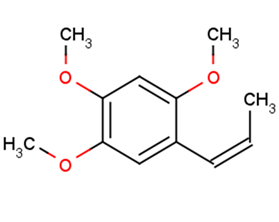
beta-Asarone
CAS No. 5273-86-9
beta-Asarone( —— )
Catalog No. M18734 CAS No. 5273-86-9
Beta-Asarone may be a potential preventive drug for Alzheimer's disease.
Purity : >98% (HPLC)
 COA
Datasheet
HNMR
HPLC
MSDS
Handing Instructions
COA
Datasheet
HNMR
HPLC
MSDS
Handing Instructions
| Size | Price / USD | Stock | Quantity |
| 1 mL x 10 mM in DMSO | 28 | In Stock |


|
| 10MG | 38 | In Stock |
|
| 25MG | 77 | In Stock |
|
| 50MG | 120 | In Stock |
|
| 100MG | 179 | In Stock |
|
| 200MG | Get Quote | In Stock |
|
| 500MG | Get Quote | In Stock |
|
| 1G | Get Quote | In Stock |
|
Biological Information
-
Product Namebeta-Asarone
-
NoteResearch use only, not for human use.
-
Brief DescriptionBeta-Asarone may be a potential preventive drug for Alzheimer's disease.
-
DescriptionBeta-Asarone may be a potential preventive drug for Alzheimer's disease. Beta-Asarone prevents autophagy and synaptic loss by reducing ROCK expression in SAMP8 mice. The co-administration of beta-Asarone and l-dopa may contribute to the treatment of 6-OHDA-induced damage in rats by inhibiting autophagy activity. 4. Beta-Asarone exhibits anti-inflammatory effects by suppressing the production of pro-inflammatory mediators through NF-κB signaling and the JNK pathways in activated microglial cells and might be developed as a promising candidate to treat various neuroinflammatory diseases.
-
In Vitro——
-
In Vivo——
-
Synonyms——
-
PathwayOthers
-
TargetOther Targets
-
RecptorNF-κB|JNK
-
Research Area——
-
Indication——
Chemical Information
-
CAS Number5273-86-9
-
Formula Weight208.25
-
Molecular FormulaC12H16O3
-
Purity>98% (HPLC)
-
SolubilityIn Vitro:?DMSO : 100 mg/mL (480.19 mM)
-
SMILESCC=CC1=CC(=C(C=C1OC)OC)OC
-
Chemical Name——
Shipping & Storage Information
-
Storage(-20℃)
-
ShippingWith Ice Pack
-
Stability≥ 2 years
Reference
molnova catalog



related products
-
(Leu8,D-Trp22,Tyr25)...
(Leu8,D-Trp22,Tyr25)-Somatostatin-28
-
Metamorphosin A
Metamorphosin A
-
Piperazine, 1-(4-flu...
Piperazine, 1-(4-fluorophenyl)-4-[(3,4,5-trimethoxyphenyl)methyl]- is a piperazine derivative.
