


 Cart
Cart
 sales@molnova.com



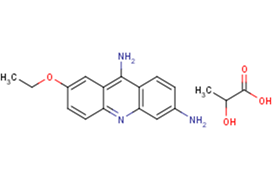
Ethacridine lactate
CAS No. 1837-57-6
Ethacridine lactate( Acrinol | 69-DIAMINO-2-ETHOXYACRIDINE LACTATE )
Catalog No. M20555 CAS No. 1837-57-6
Ethacridine lactate is a poly(ADP-ribose) glycohydrolase (PARG) inhibitor.
Purity : >98% (HPLC)
 COA
Datasheet
HNMR
HPLC
MSDS
Handing Instructions
COA
Datasheet
HNMR
HPLC
MSDS
Handing Instructions
| Size | Price / USD | Stock | Quantity |
| 100MG | 29 | In Stock |


|
| 200MG | Get Quote | In Stock |
|
| 500MG | 60 | In Stock |
|
| 1G | 85 | In Stock |
|
Biological Information
-
Product NameEthacridine lactate
-
NoteResearch use only, not for human use.
-
Brief DescriptionEthacridine lactate is a poly(ADP-ribose) glycohydrolase (PARG) inhibitor.
-
DescriptionEthacridine lactate is a poly(ADP-ribose) glycohydrolase (PARG) inhibitor.(In Vitro):Acrinol is effective against S. aureus including MRSA, with the MICs ranging from 100-200 μg/mL. The MIC of Acrinol for Eschericia coli is 200-800 μg/mL, and it is over 1,600 μg/mL for Proteus vulgaris and Proteus mirabilis.(In Vivo):Ethacridine lactate can be used for termination of pregnancy.
-
In VitroAcrinol is effective against S. aureus including MRSA, with the MICs ranging from 100-200 μg/mL. The MIC of Acrinol for Eschericia coli is 200-800 μg/mL, and it is over 1,600 μg/mL for Proteus vulgaris and Proteus mirabilis.
-
In VivoEthacridine lactate can be used for termination of pregnancy.
-
SynonymsAcrinol | 69-DIAMINO-2-ETHOXYACRIDINE LACTATE
-
PathwayOthers
-
TargetOther Targets
-
RecptorPARG
-
Research AreaInflammation/Immunology
-
IndicationBacterial infections
Chemical Information
-
CAS Number1837-57-6
-
Formula Weight343.38
-
Molecular FormulaC18H21N3O4
-
Purity>98% (HPLC)
-
SolubilityDMSO:100 mg/mL (291.22 mM)
-
SMILESCC(O)C(O)=O.CCOc1ccc2nc3cc(N)ccc3c(N)c2c1
-
Chemical NamePropanoic acid 2-hydroxy- compd. with 7-ethoxy-39-acridinediamine (1:1)
Shipping & Storage Information
-
Storage(-20℃)
-
ShippingWith Ice Pack
-
Stability≥ 2 years
Reference
1.Purandare V N Mhatre V Krishna U R et al. The place of ethacridine lactate for mid-trimester M.T.P. (Multicentric study)[J]. Journal of Postgraduate Medicine 1977 23(2):77-83.
molnova catalog



related products
-
mini-ANP
mini-ANP
-
Sarmenoside II
Sarmenoside II is a flavonol glycoside with activity that inhibits lipid accumulation. Sarmenoside II inhibits albumin-oleate-induced lipid accumulation in HepG2 cells by approximately 30% at 100 μM.
-
O-Desmethyl Quinidin...
O-Desmethyl Quinidine is a novel quinidine analog with significant antiarrhythmic activity and low acute toxicity that may be useful in the treatment of cardiac arrhythmias.
